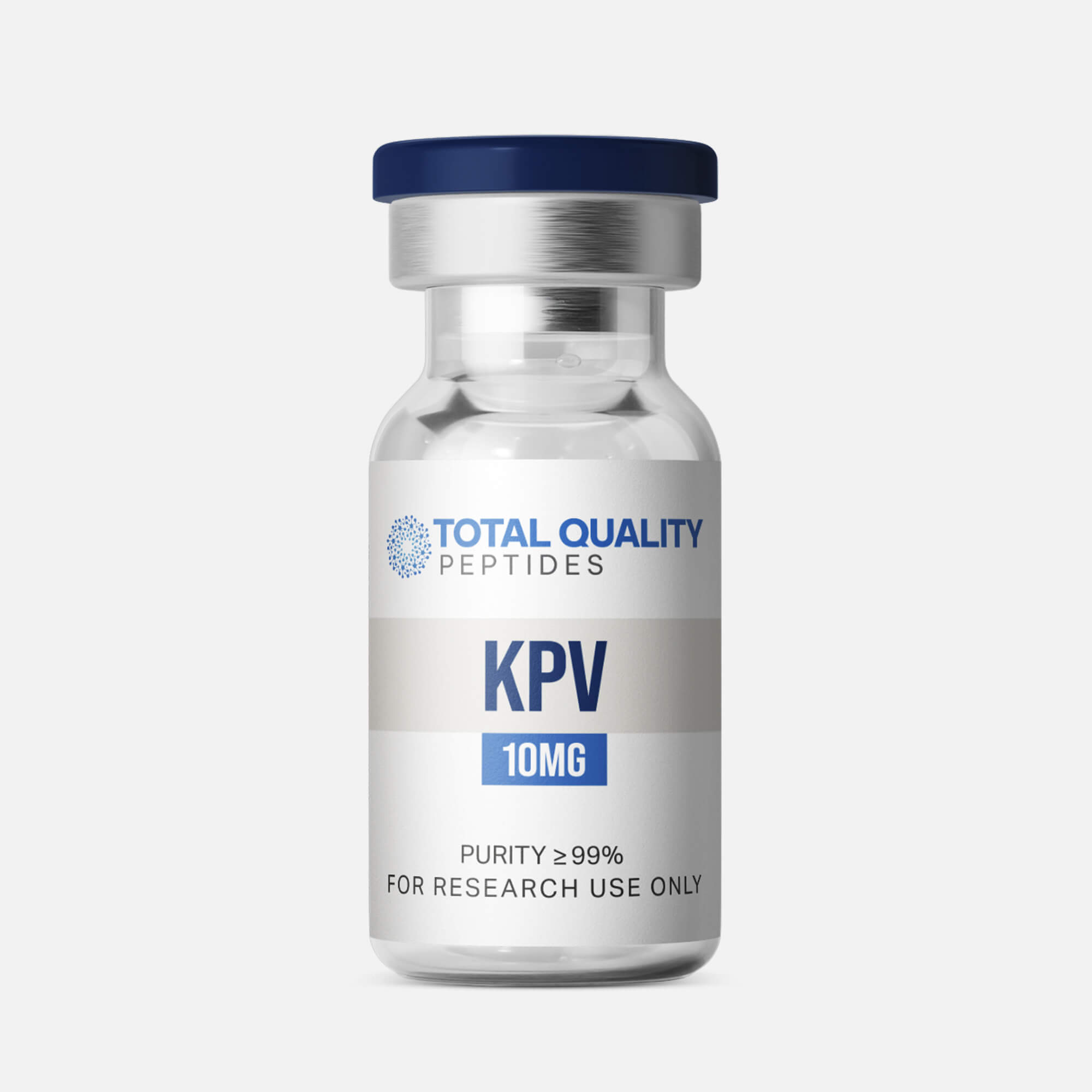
KPV – Lyophilized Powder
Product Specifications
- Peptide: KPV (Lys-Pro-Val)
- Quantity: 10mg
- Form: Lyophilized (freeze-dried) powder
- Purity: 99%+
- Molecular Formula: C16H30N4O4
- Molecular Weight: 342.43 g/mol
- CAS Number: 67727-97-3
- Sequence: H-Lys-Pro-Val-OH
- Other Designations: alpha-MSH (11-13), ACTH (11-13), alpha-MSH C-terminal tripeptide
- Storage: Store at -20C. Protect from light and moisture. Stable for 24 months when stored properly in lyophilized form.
- Appearance: White to off-white powder
- Solubility: Soluble in water and most aqueous buffers
- Third-Party Tested: Yes – Certificate of Analysis, HPLC, and Mass Spectrometry documentation available
- For research use only. Not for human consumption.
Overview
KPV is a naturally occurring tripeptide composed of three amino acids – lysine, proline, and valine – that represents the C-terminal fragment (positions 11-13) of alpha-melanocyte-stimulating hormone (alpha-MSH). Alpha-MSH is a 13-amino-acid endogenous peptide hormone produced by the pituitary gland that plays documented roles in pigmentation, metabolic regulation, and immune modulation.
Research conducted in the late 1980s identified the C-terminal tripeptide KPV as the minimum active sequence responsible for alpha-MSH’s anti-inflammatory properties. A 1989 study published in the FASEB Journal demonstrated that this isolated three-amino-acid fragment retained the parent hormone’s capacity to inhibit inflammatory responses in murine models, despite being a fraction of the full 13-amino-acid sequence. This finding established KPV as a research compound of significant interest in immunology, gastroenterology, and wound healing.
The 10mg format offered by TQ Peptides provides a research-grade quantity suitable for extended in vitro and in vivo experimental protocols. All products are supplied as lyophilized powder at 99%+ purity with full analytical documentation including Certificate of Analysis, HPLC chromatography, and mass spectrometry verification.
Mechanism of Action
KPV’s biological activity has been investigated across multiple pathways, with research suggesting several mechanisms through which the tripeptide may exert anti-inflammatory effects.
NF-kB Pathway Modulation: Research indicates that KPV may inhibit the NF-kB signaling pathway, a primary intracellular cascade that initiates and sustains inflammatory responses. NF-kB activation drives the transcription of pro-inflammatory cytokines, chemokines, and adhesion molecules. Studies suggest that KPV’s capacity to attenuate this pathway may underlie its broad anti-inflammatory profile observed across multiple tissue types.
Pro-inflammatory Cytokine Suppression: Published research has documented KPV’s potential to inhibit the synthesis and secretion of pro-inflammatory cytokines – including TNF-alpha, IL-1beta, and IL-6 – in both intestinal epithelial cells and immune cells. This cytokine suppression has been observed at nanomolar concentrations, suggesting high potency relative to the peptide’s molecular simplicity.
PepT1 Transporter Utilization: A 2008 study in Gastroenterology demonstrated that KPV is actively transported across intestinal epithelial cells via the PepT1 (peptide transporter 1) system. This finding is significant because it suggests a natural cellular uptake mechanism that delivers the peptide directly to the site of intestinal inflammation, potentially explaining the specificity of KPV’s effects in gastrointestinal research models.
Melanocortin Receptor Interaction: As a fragment of alpha-MSH, KPV has been investigated for potential interactions with melanocortin receptors, particularly MC1R. However, research suggests that KPV’s anti-inflammatory activity may be at least partially independent of MC1R signaling, indicating additional or alternative receptor-mediated pathways.
Published Research
Intestinal Inflammation and Gut Protection
KPV has been most extensively studied in the context of gastrointestinal inflammation, where multiple research groups have documented its potential protective effects.
Dalmasso et al. (2008) published a study in Gastroenterology demonstrating that KPV reduced intestinal inflammation in murine models through PepT1-mediated cellular uptake. The researchers reported that even nanomolar concentrations of KPV produced measurable anti-inflammatory effects in inflamed intestinal epithelial cells and identified PepT1 as the primary transport mechanism responsible for delivering the peptide to the site of inflammation.
Kannengiesser et al. (2008) investigated KPV in two separate murine models of inflammatory bowel disease. The study reported that KPV administration led to earlier recovery, significant body weight regain, and reduced inflammatory infiltrates in colonic tissue. These outcomes were supported by decreased myeloperoxidase (MPO) activity, indicating reduced neutrophil accumulation at sites of inflammation.
Xiao et al. (2017) developed a targeted oral delivery system using hyaluronic acid-functionalized nanoparticles to transport KPV directly to inflamed colonic tissue. Published in Molecular Therapy, the study reported that this delivery method significantly alleviated ulcerative colitis symptoms in murine models, with KPV exhibiting the capacity to protect mucosal surfaces and downregulate TNF-alpha expression.
Anti-Inflammatory Activity
The foundational anti-inflammatory research on KPV was published by Hiltz and Lipton (1989) in the FASEB Journal. This study demonstrated that the isolated C-terminal tripeptide of alpha-MSH retained the full-length hormone’s ability to inhibit inflammation – specifically, KPV reduced ear swelling in mice exposed to inflammatory irritants.
Luger and Brzoska (2007) published a comparative analysis in the Annals of the Rheumatic Diseases examining KPV alongside full-length alpha-MSH in models of contact dermatitis. Both compounds produced equivalent anti-inflammatory effects over 24 hours, though the full-length hormone exhibited longer-lasting effects after treatment cessation, suggesting differences in receptor binding kinetics or in downstream signaling persistence between the fragment and the parent molecule.
Brzoska et al. (2008) published a comprehensive review in the Endocrine Reviews examining alpha-MSH and its related tripeptides, including KPV, as potential anti-inflammatory and immunomodulating agents. The review consolidated evidence from multiple research groups and proposed that KPV and related alpha-MSH fragments represent a novel class of anti-inflammatory compounds with potential applications in immune-mediated inflammatory diseases.
Wound Healing
Bonfiglio et al. (2006) investigated the effects of KPV on corneal epithelial wound healing in an ex vivo model. Published in Experimental Eye Research, the study reported that KPV-treated corneas achieved complete re-epithelialization within 60 hours, whereas none in the control group achieved complete healing. The researchers further demonstrated that this accelerated healing involved nitric oxide (NO) dynamics, as pre-treatment with the NO synthase inhibitor L-NAME blocked the effect. In vitro experiments showed KPV stimulated cell viability at concentrations of 1 and 10 micromolar.
Scar Formation
De Souza et al. (2015) published research in Experimental Dermatology examining KPV’s effects on wound healing and scar formation in murine models. Mice treated with KPV exhibited improved healing markers at days 3 and 7 post-incision, with reduced inflammatory cell infiltration, including leukocytes and mast cells. At days 40 and 60, KPV-treated mice showed significantly smaller scar areas compared to controls, suggesting that the peptide’s anti-inflammatory activity during the early healing phase may translate into improved long-term cosmetic outcomes.
Antipyretic Activity
Richards and Lipton (1984) published early research in Peptides demonstrating KPV’s antipyretic potential in a rabbit model. The study reported that KPV administration reduced elevated body temperature to normal physiological levels, suggesting that the C-terminal fragment retains the thermoregulatory properties of the parent alpha-MSH hormone.
Storage and Handling
- Store lyophilized powder at -20C (freezer)
- Protect from light, heat, and moisture.
- Reconstituted solutions should be stored at 4C and used within 14 days.
- For long-term storage of reconstituted peptide, aliquot and store at -20C to avoid repeated freeze-thaw cycles
- Stable for 24 months in lyophilized form when stored at the recommended temperature
Why TQ Peptides?
- 99%+ purity on every peptide
- Full analytical documentation: COA, HPLC, Mass Spectrometry
- 10mg research-grade quantity for extended experimental protocols
- Competitive pricing with volume discounts available
- Fast shipping on all orders
Frequently Asked Questions
What is KPV?
KPV is a naturally occurring tripeptide (three amino acids: lysine, proline, valine) that represents the C-terminal fragment (positions 11-13) of alpha-melanocyte-stimulating hormone (alpha-MSH). Research conducted since the late 1980s has identified KPV as the minimum active sequence responsible for alpha-MSH’s anti-inflammatory properties. The peptide has been studied primarily in the contexts of intestinal inflammation, wound healing, scar formation, and immune modulation.
What is the molecular weight and formula of KPV?
Molecular formula: C16H30N4O4. Molecular weight: 342.43 g/mol. KPV is one of the smallest bioactive peptides studied in inflammatory research, consisting of only three amino acid residues.
What is the relationship between KPV and alpha-MSH?
Alpha-MSH is a 13-amino-acid endogenous hormone produced by the pituitary gland. KPV represents amino acid positions 11, 12, and 13 of the alpha-MSH sequence – the C-terminal end. Research has demonstrated that this three-amino-acid fragment retains the parent hormone’s anti-inflammatory activity, making it the minimum active sequence for this biological function.
What research areas has KPV been studied in?
The primary research areas include intestinal inflammation and gut protection (inflammatory bowel disease models, colitis models, intestinal epithelial cell studies), general anti-inflammatory activity (dermatitis models, cytokine suppression), wound healing (corneal epithelial repair, skin wound models), scar formation (reduced scar area in murine models), and antipyretic activity (fever reduction in animal models). The most extensive published research focuses on gastrointestinal applications.
What is the PepT1 transport mechanism?
PepT1 (peptide transporter 1) is a naturally occurring transport protein expressed on intestinal epithelial cells. A 2008 study in Gastroenterology demonstrated that KPV is actively transported across intestinal cells via PepT1, which may explain the specificity of KPV’s anti-inflammatory effects in gastrointestinal tissue – the peptide has a built-in delivery mechanism to the site of inflammation.
What is the purity of this product?
99%+ purity, verified by HPLC (High-Performance Liquid Chromatography) and confirmed by Mass Spectrometry. A full Certificate of Analysis is available for every batch.
How should KPV be stored?
Store the lyophilized powder at -20 °C, protected from light and moisture. Stable for 24 months in lyophilized form. Reconstituted solutions should be stored at 4C and used within 14 days, or aliquoted and stored at -20C for longer-term use.
What is the solubility of KPV?
KPV is soluble in water and most standard aqueous buffers, making it straightforward to prepare for in vitro and in vivo research applications.
Why 10mg instead of smaller quantities?
The 10mg format provides a research-grade quantity suitable for extended experimental protocols, dose-response studies, and multi-experiment research programs. Smaller quantities (3-5 mg) are common on the market but limit the scope of research that can be conducted from a single vial.
References
- Dalmasso, G., Charrier-Hisamuddin, L., Nguyen, H. T., Yan, Y., Sitaraman, S., & Merlin, D. (2008). PepT1-mediated uptake of the tripeptide KPV reduces intestinal inflammation. Gastroenterology, 134(1), 166-178. https://doi.org/10.1053/j.gastro.2007.10.026
- Hiltz, M. E., & Lipton, J. M. (1989). Anti-inflammatory activity of a COOH-terminal fragment of the neuropeptide alpha-MSH. FASEB Journal, 3(11), 2282-2284. PubMed: 2550304
- Brzoska, T., Luger, T. A., Maaser, C., Abels, C., & Bohm, M. (2008). Alpha-melanocyte-stimulating hormone and related tripeptides: biochemistry, anti-inflammatory and protective effects in vitro and in vivo, and future perspectives for the treatment of immune-mediated inflammatory diseases. Endocrine Reviews, 29(5), 581-602. https://doi.org/10.1210/er.2007-0027
- Kannengiesser, K., Maaser, C., Heidemann, J., Luegering, A., Ross, M., Brzoska, T., Bohm, M., Luger, T. A., Domschke, W., & Kucharzik, T. (2008). Melanocortin-derived tripeptide KPV has anti-inflammatory potential in murine models of inflammatory bowel disease. Inflammatory Bowel Diseases, 14(3), 324-331. https://doi.org/10.1002/ibd.20334
- Xiao, B., Xu, Z., Viennois, E., Zhang, Y., Zhang, Z., Zhang, M., Han, M. K., Kang, Y., & Merlin, D. (2017). Orally Targeted Delivery of Tripeptide KPV via Hyaluronic Acid-Functionalized Nanoparticles Efficiently Alleviates Ulcerative Colitis. Molecular Therapy, 25(7), 1628-1640. https://doi.org/10.1016/j.ymthe.2016.11.020
- Luger, T. A., & Brzoska, T. (2007). Alpha-MSH-related peptides: a new class of anti-inflammatory and immunomodulating drugs. Annals of the Rheumatic Diseases, 66(Suppl 3), iii52-iii55. PMC: 2095288
- Bonfiglio, V., Camillieri, G., Avitabile, T., Leggio, G. M., & Drago, F. (2006). Effects of the COOH-terminal tripeptide alpha-MSH(11-13) on corneal epithelial wound healing: role of nitric oxide. Experimental Eye Research, 83(6), 1366-1372. https://doi.org/10.1016/j.exer.2006.07.014
- de Souza, K. S., Cantaruti, T. A., Azevedo, G. M. Jr., Galdino, D. A., Rodrigues, C. M., Costa, R. A., Vaz, N. M., & Carvalho, C. R. (2015). Improved cutaneous wound healing after intraperitoneal injection of alpha-melanocyte-stimulating hormone. Experimental Dermatology, 24(3), 198-203. PubMed: 25431356
- Richards, D. B., & Lipton, J. M. (1984). Effect of alpha-MSH 11-13 (lysine-proline-valine) on fever in the rabbit. Peptides, 5(4), 815-817. https://doi.org/10.1016/0196-9781(84)90027-5
Disclaimer
For research use only. Not for human consumption. This product is not a drug, medicine, or therapeutic agent. It is not intended to diagnose, treat, cure, or prevent any disease or medical condition. The information on this page summarizes published scientific research and is intended for the educational use of qualified researchers. The statements on this page have not been evaluated by the Food and Drug Administration. Purchasers must be qualified researchers and agree to use this product in accordance with all applicable laws and regulations.