Product Specifications
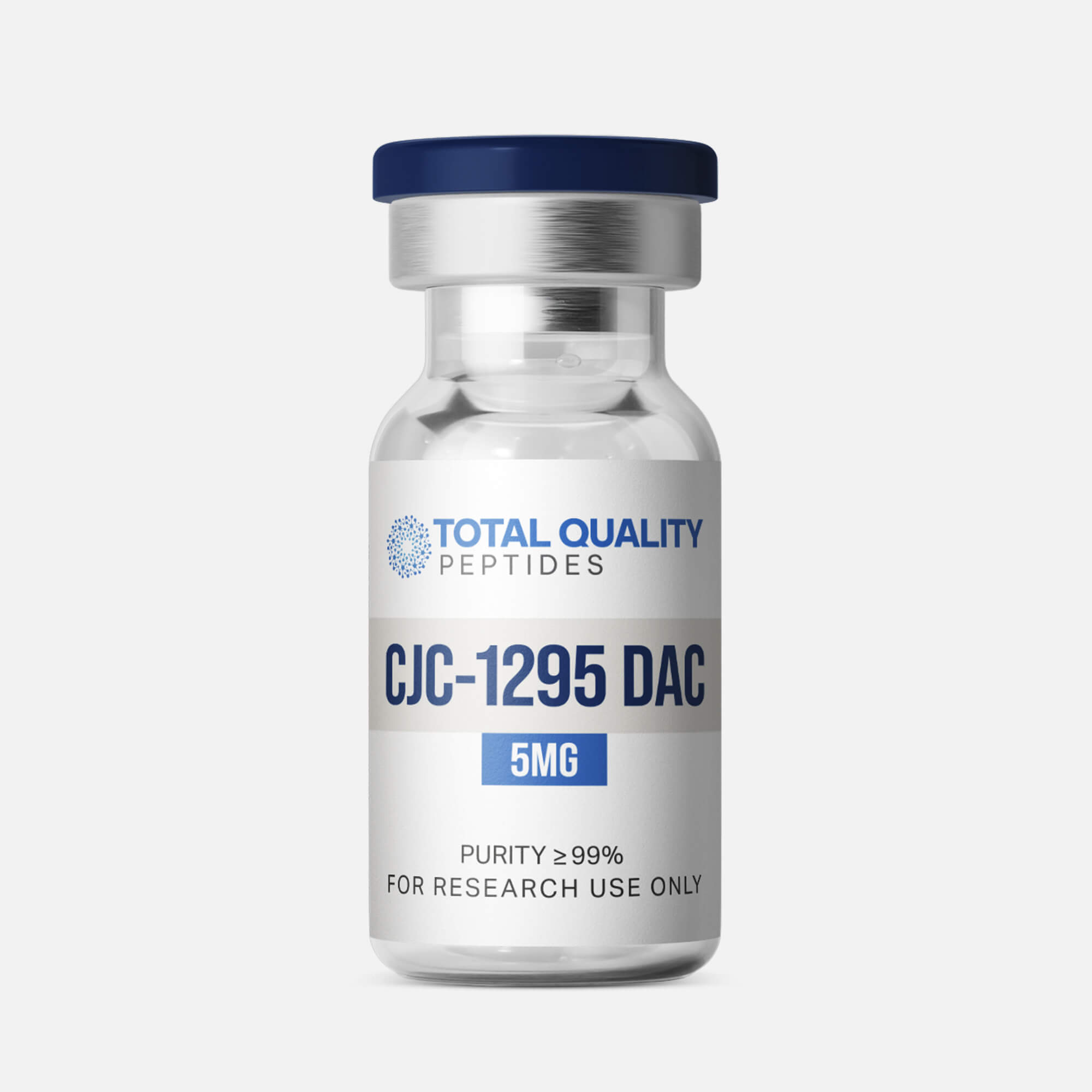
- Peptide: CJC-1295 DAC (CJC-1295 with Drug Affinity Complex)
- Other Designations: DAC:GRF (Drug Affinity Complex-Growth Hormone-Releasing Factor), Tetrasubstituted GRF 1-29 with DAC (indicating four amino acid changes), Long-Acting GHRH (Growth Hormone-Releasing Hormone) Analog
- Available Size: 5mg
- Form: Lyophilized (freeze-dried) powder
- Purity: >99%
- Amino Acid Count: 29 (with 4 amino acid substitutions from native GHRH 1-29)
- Molecular Formula: C₁₅₂H₂₅₂N₄₄O₄₂
- Molecular Weight: 3367.95 g/mol
- Half-Life: Approximately 6–8 days (due to DAC technology)
- Origin: Wholly synthetic — a modified analog (similar structure) of human growth hormone-releasing hormone (GHRH)
- Storage: Store lyophilized (freeze-dried) powder at -20°C. Once reconstituted (mixed with liquid), store at 2–8°C and use within 30 days.
- Intended Use: For laboratory and research purposes only. Not for human consumption.
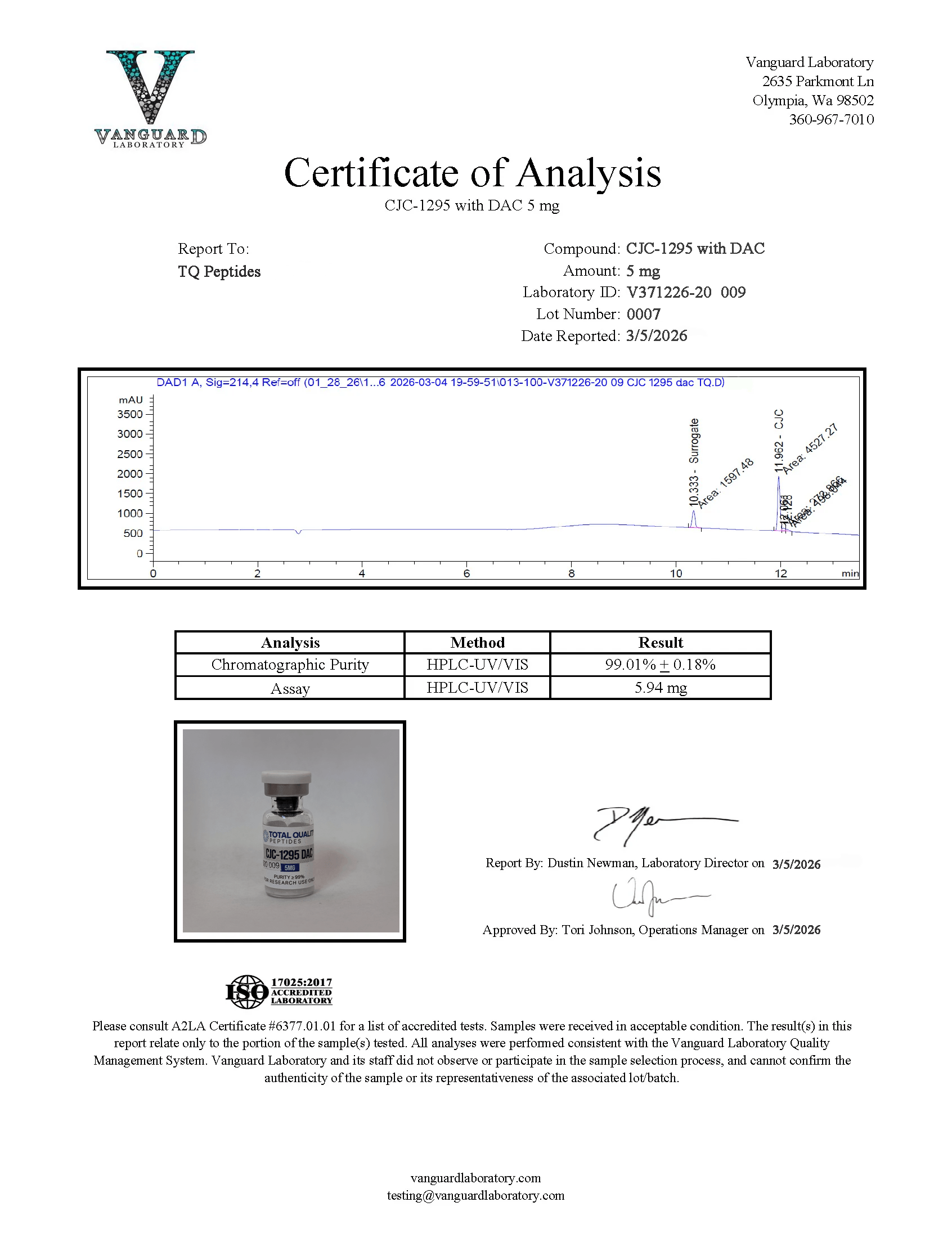
- Third-party tested with Certificate of Analysis (an independent document verifying quality and specifications) available.
What Is CJC-1295 DAC?
CJC-1295 DAC is a synthetic peptide of 29 amino acids. It acts as a long-acting analog of growth hormone-releasing hormone (GHRH). It is the shortest functional fragment of GHRH shown in research to keep the ability to stimulate growth hormone (GH) release from somatotroph cells of the anterior pituitary gland.
CJC-1295 DAC stands apart from native GHRH and shorter-acting GHRH analogs due to two layers of molecular engineering. These modifications sharply extend the peptide’s duration in the body.
First change: Four parts in the original GHRH 1-29 are switched out to help make the peptide more stable and harder for the body to break down:
- At spot 2, L-alanine is replaced by D-alanine, making it harder for certain body enzymes to break down the peptide.
- At spot 8, asparagine is replaced with glutamine, which helps reduce the risk of unwanted changes to the peptide.
- Position 15 — Glycine is switched for alanine, which may increase the peptide’s activity.
- Position 27 — Methionine is switched for leucine, which helps stop methionine from being damaged.
These substitutions alone raise the half-life from about 7 minutes (native GHRH) to about 30 minutes. This is a meaningful improvement, but the half-life is still fairly short for research needing sustained GH elevation.
Layer two is the Drug Affinity Complex (DAC). The defining feature is attaching a lysine derivative, N-epsilon-3-maleimidopropionamide, to the peptide’s C-terminus. This lets the peptide bind to albumin and other plasma proteins after reconstitution. It forms a circulating reservoir that releases active peptide over time. DAC technology extends the half-life from 30 minutes to about 6–8 days. This shift changes the peptide from a pulse-style to a sustained-release platform for research.
The end result is a peptide that stays active for roughly 100 times longer than the native hormone. It also maintains a strong affinity for GHRH receptors.
How CJC-1295 DAC Works — Proposed Mechanism of Action
CJC-1295 DAC is thought to act by binding to GHRH receptors on somatotroph cells in the anterior pituitary, thereby increasing growth hormone (GH) synthesis and secretion through activation of intracellular signaling pathways.
The signaling cascade likely happens in stages. When CJC-1295 DAC binds to the GHRH receptor, it likely induces conformational changes in the receptor. This activates G-proteins (Gs proteins) inside the membrane. G-proteins encourage the production of secondary messengers, mainly cyclic adenosine monophosphate (cAMP), which amplify signals in the cell.
cAMP is believed to activate protein kinase A (PKA) and related enzymes that phosphorylate transcription factors, thereby controlling gene expression. When phosphorylated, these transcription factors are likely to move into the nuclei of somatotroph cells. There, they may influence genes involved in growth hormone production and secretion.
A rise in GH leads to the production of insulin-like growth factor 1 (IGF-1), primarily in the liver and other tissues. GH likely binds to receptors on hepatocytes (liver cells), triggering the Janus kinase-signal transducer and activator of transcription (JAK-STAT) pathway. Activated STAT proteins enter the nucleus and bind to IGF-1 gene response elements, initiating transcription. The resulting IGF-1 is considered a potent mediator of many growth and anabolic effects linked to growth hormone. It promotes cell growth, proliferation, protein synthesis, and tissue development.
CJC-1295 DAC stands out for its DAC technology, which enables the signaling cascade to persist for days rather than minutes. Native GHRH triggers a brief pulse of GH secretion that quickly fades. In contrast, CJC-1295 DAC has been reported to maintain elevated GH and IGF-1 levels for much longer. This change alters the pharmacokinetic profile for research.
Preclinical and Clinical Research Overview
CJC-1295 DAC has been investigated in animal models (non-human research subjects) and in human clinical trials (studies in people). Below is a detailed summary of published findings by research focus.nd Growth Hormone / IGF-1 Elevation
The most extensively studied aspect of CJC-1295 DAC is its potential to sustain elevated levels of growth hormone and insulin-like growth factor 1 (IGF-1).
In two clinical studies from 2006, healthy adults received either CJC-1295 DAC or a placebo. In the first study, the peptide was administered at increasing concentrations as a single dose. In the second, it was given repeatedly at a set concentration. Researchers reported that after peptide administration, subjects showed significant increases in GH and IGF-1 levels. Key results included:
- GH levels increased by 2- to 10-fold above baseline for approximately 6 days or longer following a single presentation.
- IGF-1 levels rose by 1.5- to 3-fold above baseline. These increases lasted about 9–11 days.
- IGF-1 levels reportedly remained above baseline for at least two weeks following presentation
- After repeated doses, IGF-1 levels stayed above baseline for up to 28 days.
- A cumulative effect was observed with repeated presentations — each subsequent dose appeared to build on the elevation produced by the prior dose.
A separate 2006 study measured GH pulsatility following a single dose of CJC-1295 DAC. The study found that the peptide appeared to preserve the normal pulsatile pattern of GH secretion, not causing a constant, unnatural elevation. Mean GH secretion went up by about 50%, and peak GH levels rose by as much as 7.5-fold. The pulse rhythm stayed intact. This preservation matters because it suggests that CJC-1295 DAC may support the body’s natural GH patterns rather than override them.
CJC-1295 DAC and Body Composition
Animal studies have examined whether sustained elevations in GH and IGF-1 induced by CJC-1295 DAC alter body composition, including lean and fat mass.
One study used murine models lacking the GHRH gene (GHRHKO mice). These mice cannot make GHRH, leading to growth hormone deficiency and reduced lean mass with increased fat mass.
The findings were substantial:
- Daily presentation of CJC-1295 DAC appeared to completely normalize growth in the GHRHKO models.
- Presentation every 2 or 3 days appeared to produce intermediate results, suggesting a dose-interval-dependent response.
- Models receiving CJC-1295 DAC maintained normal lean mass levels, whereas untreated GHRHKO models exhibited reduced lean mass.
- Subcutaneous fat mass in the CJC-1295 DAC groups stayed at control (normal) levels. Untreated GHRHKO mice showed higher fat.
- Pituitary RNA and GH mRNA levels increased after CJC-1295 DAC was given. This suggests somatotroph cells (GH-producing pituitary cells) may have grown in number.
The researchers confirmed somatotroph cell growth using immunohistochemistry. They noted increases in pituitary RNA and GH mRNA after CJC-1295 DAC. This suggests the peptide may help create new GH-producing cells rather than just stimulate existing ones. This mechanism could explain the cumulative effects seen in clinical trials.
CJC-1295 DAC and Sleep Architecture
While CJC-1295 DAC research does not primarily focus on sleep, its link to GHRH places it within a research context that includes sleep regulation.
Published research has established that GHRH plays a role in supporting sleep-related processes in the central nervous system. Studies on GHRH and its analogs have suggested that these molecules may support the neural centers involved in sleep initiation and maintenance. As a functional GHRH analog, CJC-1295 DAC is hypothesized to potentially mirror this activity — though direct studies of CJC-1295 DAC’s specific effects on sleep architecture remain limited.
This area represents a potential avenue for future investigation, particularly given that CJC-1295 DAC’s extended half-life could make it a useful tool for studying the sustained effects of GHRH-receptor activation on sleep patterns over multi-day periods.
CJC-1295 DAC Half-Life Comparison
Understanding the half-life advantage of CJC-1295 DAC requires situating it within the GHRH analog family. The progression from native GHRH to CJC-1295 DAC represents three distinct generations of engineering, each dramatically extending functional duration:
- Native GHRH (1-44) — Half-life of approximately 7 minutes. Rapidly degraded by dipeptidyl peptidase-4 (DPP-IV) and other serum proteases. Functionally useful only in pulse-format research applications.
- CJC-1295 without DAC (Mod GRF 1-29) — Half-life of approximately 30 minutes. The four amino acid substitutions at positions 2, 8, 15, and 27 provide meaningful resistance to enzymatic degradation but still require frequent re-dosing in research protocols.
- CJC-1295 with DAC — Half-life of approximately 6–8 days. The Drug Affinity Complex enables albumin binding in plasma, creating a sustained-release reservoir. A single presentation can maintain elevated GH and IGF-1 levels for over a week.
This 1,000-fold improvement in functional duration — from 7 minutes to 6–8 days — is one of the most dramatic pharmacokinetic transformations achieved in the peptide research field. It enables experimental protocols that would be impractical with shorter-acting analogs, including multi-day and multi-week studies of sustained GH axis stimulation with minimal intervention frequency.
CJC-1295 DAC vs CJC-1295 without DAC — Key Differences for Researchers
Both forms of CJC-1295 share the same tetrasubstituted GRF 1-29 backbone and the same four amino acid modifications. The distinction lies entirely in the DAC component and its consequences for pharmacokinetics:
- CJC-1295 without DAC produces a brief, pulse-like elevation in GH that mimics the natural secretory pattern. Its short duration makes it useful for studying acute, pulsatile GH release. It is often paired with ghrelin receptor agonists, such as ipamorelin, in blend research to investigate potential synergistic GH-secretion responses from simultaneous activation of the GHRH and ghrelin pathways.
- CJC-1295 with DAC produces a sustained, multi-day elevation in both GH and IGF-1. Its extended duration makes it useful for studying the chronic effects of GH axis stimulation — including body composition changes, somatotroph cell proliferation, and cumulative IGF-1 elevation over weeks.
The choice between the two depends entirely on the research question. Pulse-pattern studies favor the non-DAC version. Sustained-elevation and chronic-effect studies favor CJC-1295 DAC.
Ancillary Research and Regulatory Context
In 2005, a clinical study was designed to evaluate CJC-1295 DAC in models of immunodeficiency virus (HIV)-associated visceral obesity — a condition characterized by abnormal fat distribution believed to be partially driven by disrupted GH/IGF-1 axis function. The planned protocol involved three months of CJC-1295 DAC presentation followed by a six-week follow-up period. However, this study was terminated during the recruitment phase, and no results were published.
Separately, in 2009, the Norwegian Doping Control Laboratory and School of Pharmacy analyzed a submitted compound and identified it as CJC-1295 DAC. Their published report confirmed the peptide’s identity and characterized it as a growth hormone-releasing factor, contributing to the compound’s regulatory and analytical characterization for anti-doping purposes.
Summary of Key Research Findings
- GH Elevation — 2- to 10-fold increase in mean GH levels sustained for approximately 6 days after a single presentation; peak GH levels increased by up to 7.5-fold
- IGF-1 Elevation — 1.5- to 3-fold increase sustained for 9–11 days; levels remained above baseline for at least 2 weeks; following repeated presentations, elevated levels persisted for up to 28 days
- Pulsatility Preservation — CJC-1295 DAC appeared to maintain the natural pulsatile pattern of GH secretion rather than producing constant elevation
- Cumulative Effect — Repeated presentations appeared to build on prior elevations, suggesting a stacking effect over time
- Body Composition — Daily presentation completely normalized growth in GHRH-knockout models; preserved lean mass at normal levels; prevented fat mass accumulation; intermediate results observed with every-2-or-3-day protocols
- Somatotroph Proliferation — Increased pituitary RNA and GH mRNA levels suggested the development of new growth hormone-producing cells, confirmed by immunohistochemistry.
- Half-Life — Approximately 6–8 days with DAC, compared to 30 minutes without DAC and 7 minutes for native GHRH
- Sleep — GHRH has established roles in supporting sleep-related neural processes; CJC-1295 DAC may mirror this activity as a functional analog
Handling and Reconstitution
- Store lyophilized powder at -20°C for long-term stability.
- Reconstitute with bacteriostatic water or sterile water for injection.
- Once reconstituted, store at 2–8°C (refrigerator temperature)
- Use the reconstituted solution within 30 days.
- Avoid repeated freeze-thaw cycles.
- The DAC component’s albumin-binding properties are only relevant in biological systems — in-vial stability is governed by standard peptide storage protocols.
- Handle with appropriate laboratory safety protocols.
Quality Assurance
- Purity verified at >99% by high-performance liquid chromatography (HPLC)
- Identity confirmed by mass spectrometry (MS)
- Certificate of Analysis (COA) available for every batch
- Third-party tested for purity, identity, and consistency.
- Supplied as lyophilized (freeze-dried) powder for maximum stability
Frequently Asked Questions
What is CJC-1295 DAC?
CJC-1295 DAC is a synthetic 29-amino-acid peptide that functions as a long-acting analog of growth hormone-releasing hormone (GHRH). The DAC (Drug Affinity Complex) component enables the peptide to bind to plasma proteins, extending its functional half-life to approximately 6–8 days. It has been studied for its potential to sustain elevated levels of growth hormone and IGF-1.
What does DAC stand for?
Drug Affinity Complex. It refers to the attachment of a lysine derivative (N-epsilon-3-maleimidopropionamide) to the C-terminus of the peptide, which enables binding to albumin and other plasma proteins for extended circulating duration.
How is CJC-1295 DAC different from CJC-1295 without DAC?
Both share the same tetrasubstituted GRF 1-29 backbone. CJC-1295 without DAC has a half-life of approximately 30 minutes and produces pulse-like GH elevations. CJC-1295 with DAC has a half-life of approximately 6–8 days and produces sustained, multi-day elevations of GH and IGF-1. The non-DAC version is used to study pulsatile GH release; the DAC version is used to study chronic, sustained GH-axis stimulation.
How long does CJC-1295 DAC remain active?
Research indicates that a single presentation of CJC-1295 DAC may maintain elevated GH levels for approximately 6 days and elevated IGF-1 levels for 9–11 days or longer. Following repeated presentations, IGF-1 levels have been reported to remain above baseline for up to 28 days.
Does CJC-1295 DAC preserve natural GH pulsatility?
Yes. One clinical study demonstrated that CJC-1295 DAC appeared to increase mean GH secretion by approximately 50% while preserving the natural pulsatile pattern of GH release — suggesting augmentation of existing secretory rhythms rather than replacement with a constant non-physiological elevation.
What is the half-life of native GHRH compared to CJC-1295 DAC?
Native GHRH has a half-life of approximately 7 minutes. CJC-1295 without DAC extends this to approximately 30 minutes. CJC-1295 with DAC extends it to approximately 6–8 days, representing roughly a 1,000-fold improvement over the native hormone.
Has CJC-1295 DAC been tested in clinical studies?
Yes. Two clinical studies in healthy adults (2006) demonstrated sustained elevations in GH and IGF-1 following both single and repeated presentations. A separate study confirmed preservation of GH pulsatility. An HIV-associated visceral obesity trial was designed but terminated during recruitment without published results.
What is the purity of this product?
Greater than 99%, verified by third-party HPLC and mass spectrometry. A Certificate of Analysis is available for every batch.
What size is available?
5mg.
How should I store this product?
Store lyophilized powder at -20°C. Once reconstituted, store at 2–8°C and use within 30 days. Avoid repeated freeze-thaw cycles.
What is this product intended for?
This product is intended for laboratory and research purposes only. It is not intended for human consumption, therapeutic use, or diagnostic purposes.
References
- Henninge, J., Pepaj, M., Hullstein, I., & Hemmersbach, P. (2010). Identification of CJC-1295, a growth-hormone-releasing peptide, in an unknown pharmaceutical preparation. Drug Testing and Analysis, 2(11–12), 647–650. https://doi.org/10.1002/dta.233
- Jetté, L., Léger, R., Thibaudeau, K., Benquet, C., Robitaille, M., Pellerin, I., Paradis, V., van Wyk, P., Pham, K., & Bhidon, D. P. (2005). Human growth hormone-releasing factor (hGRF)1-29-albumin bioconjugates activate the GRF receptor on the anterior pituitary in rats: identification of CJC-1295 as a long-lasting GRF analog. Endocrinology, 146(7), 3052–3058. https://doi.org/10.1210/en.2004-1286
- Sinha, D. K., Balasubramanian, A., Tatem, A. J., Rivera-Mirabal, J., Yu, J., Kovac, J., Pastuszak, A. W., & Lipshultz, L. I. (2020). Beyond the androgen receptor: the role of growth hormone secretagogues in the modern management of body composition in hypogonadal males. Translational Andrology and Urology, 9(Suppl 2), S149–S159. https://doi.org/10.21037/tau.2019.11.30
- Steiger, A., & Holsboer, F. (1997). Neuropeptides and human sleep. Sleep, 20(11), 1038–1052. https://pubmed.ncbi.nlm.nih.gov/9456470/
- Teichman, S. L., Neale, A., Lawrence, B., Gagnon, C., Castaigne, J. P., & Frohman, L. A. (2006). Prolonged stimulation of growth hormone (GH) and insulin-like growth factor I secretion by CJC-1295, a long-acting analog of GH-releasing hormone, in healthy adults. Journal of Clinical Endocrinology & Metabolism, 91(3), 799–805. https://doi.org/10.1210/jc.2005-1536
- Ionescu, M., & Frohman, L. A. (2006). Pulsatile secretion of growth hormone (GH) persists during continuous stimulation by CJC-1295, a long-acting GH-releasing hormone analog. Journal of Clinical Endocrinology & Metabolism, 91(12), 4792–4797. https://doi.org/10.1210/jc.2006-1702
- Martin, B., Lopez de Maturana, R., Brenneman, R., Walent, T., Mattson, M. P., & Maudsley, S. (2005). Class II G protein-coupled receptors and their ligands in neuronal function and protection. Neuromolecular Medicine, 7(1–2), 3–36. https://doi.org/10.1385/nmm:7:1-2:003
- Newton, A. C., Bootman, M. D., & Scott, J. D. (2016). Second Messengers. Cold Spring Harbor Perspectives in Biology, 8(8), a005926. https://doi.org/10.1101/cshperspect.a005926
- Alba, M., Fintini, D., Sagazio, A., Lawrence, B., Castaigne, J. P., Frohman, L. A., & Salvatori, R. (2006). Once-daily administration of CJC-1295, a long-acting growth hormone-releasing hormone (GHRH) analog, normalizes growth in the GHRH knockout mouse. American Journal of Physiology — Endocrinology and Metabolism, 291(6), E1290–E1294. https://doi.org/10.1152/ajpendo.00201.2006
- Van Hout, M. C., & Hearne, E. (2016). Netnography of Female Use of the Synthetic Growth Hormone CJC-1295: Pulses and Potions. Substance Use & Misuse, 51(1), 73–84. https://doi.org/10.3109/10826084.2015.1082595
- ClinicalTrials.gov. A Study of CJC-1295 in HIV-Associated Visceral Obesity. Identifier: NCT00267527. https://clinicaltrials.gov/ct2/show/NCT00267527
Disclaimer
This product is sold for research and laboratory use only. It is not a drug, food, cosmetic, or supplement. It is not intended to diagnose, treat, cure, or prevent any disease or medical condition. It is not approved for human or veterinary use. The information provided on this page is drawn from published preclinical and clinical research literature and is presented for informational purposes only. Researchers are responsible for ensuring compliance with all applicable regulations governing the purchase, handling, and use of research peptides in their jurisdiction.