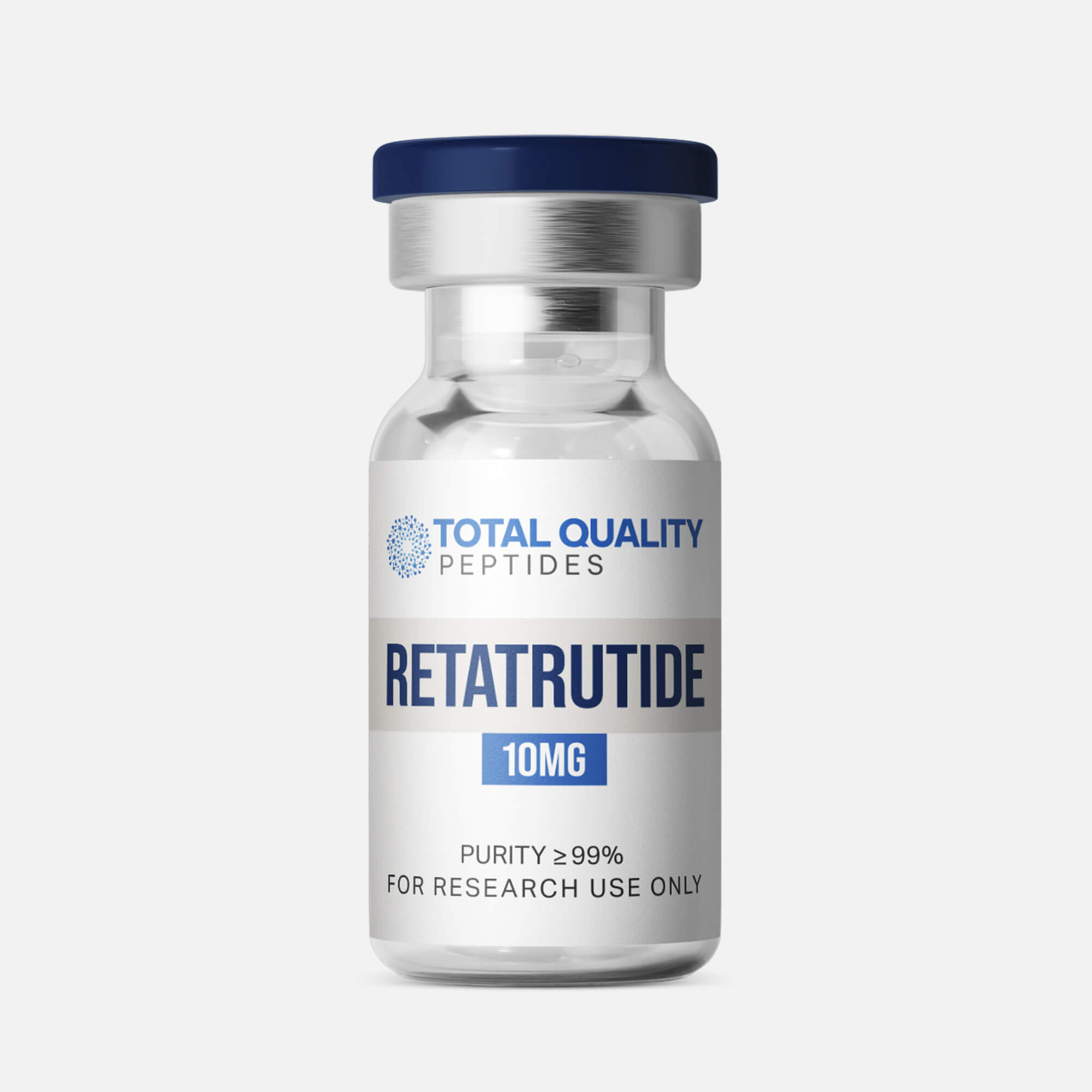
Retatrutide – Triple GLP-1/GIP/Glucagon Receptor Agonist
Product Specifications
- Peptide: Retatrutide (LY3437943)
- Quantity: 10mg
- Form: Lyophilized (freeze-dried) powder
- Purity: 99%+ (HPLC and Mass Spectrometry verified)
- Molecular Formula: C256H392N64O79
- Molecular Weight: 4731.2 g/mol
- CAS Number: 2381089-83-2
- Amino Acid Count: 39 residues
- Sequence: 39-residue GIP/GLP-1/glucagon triple agonist incorporating Aib residues, alpha-methylleucine, and a lysine-conjugated (AEEA)-gammaGlu-C20 diacid fatty acid moiety; C-terminal serinamide
- Other Designations: LY3437943, GGG tri-agonist
- Physical Form: Lyophilized powder (white to off-white)
- Solubility: Soluble in bacteriostatic water and standard aqueous buffers
- Storage: Store at -20C. Protect from light and moisture. Reconstituted solutions should be refrigerated at 2-8C.
- Third-Party Tested: Yes – Certificate of Analysis, HPLC, and Mass Spectrometry documentation available
- For research use only. Not for human consumption.
Overview
Retatrutide represents a structural and pharmacological departure from the single- and dual-agonist peptides that preceded it in metabolic research. Where semaglutide activates one receptor (GLP-1), and tirzepatide activates two (GLP-1 and GIP), retatrutide was engineered to activate three: GLP-1, GIP, and glucagon receptors simultaneously. This triple-agonist mechanism is the defining characteristic that has generated significant research interest since the compound’s initial characterization.
The 10mg format offered by TQ Peptides provides research-grade material suitable for in vitro receptor binding assays, cell-based signaling studies, and other controlled laboratory investigations.
Mechanism of Action: The Triple-Agonist Approach
Retatrutide’s pharmacological profile is defined by its simultaneous engagement of three distinct receptor systems, each contributing a different metabolic effect.
GLP-1 Receptor Agonism
Glucagon-like peptide-1 (GLP-1) receptor activation is the best-characterized pathway in the incretin peptide class. GLP-1 receptor agonism promotes glucose-dependent insulin secretion from pancreatic beta cells, suppresses glucagon release from alpha cells (reducing hepatic glucose output), delays gastric emptying (promoting satiety), and acts on hypothalamic appetite centers to reduce food intake. This pathway is the foundation of semaglutide’s (Ozempic/Wegovy) mechanism and is the most extensively validated of the three receptor targets.
GIP Receptor Agonism
Glucose-dependent insulinotropic polypeptide (GIP) receptor activation adds a second incretin axis. GIP receptor agonism potentiates insulin secretion in a glucose-dependent manner, may influence lipid metabolism in adipose tissue, and – when combined with GLP-1 receptor activation – appears to produce greater metabolic effects than GLP-1 agonism alone. This dual-agonist principle underlies tirzepatide (Mounjaro/Zepbound), which activates both GLP-1 and GIP receptors.
Glucagon Receptor Agonism
Glucagon receptor activation is what makes retatrutide structurally and mechanistically distinct from all approved metabolic peptides. Glucagon agonism increases hepatic glucose production (potentially counterproductive in isolation, but modulated by the concurrent GLP-1 activity), stimulates energy expenditure through thermogenesis, promotes hepatic lipid oxidation (fat burning in the liver), and may increase resting metabolic rate. The glucagon component is the primary driver of retatrutide’s documented effects on liver fat reduction and is the pharmacological rationale for calling it a “triple agonist” rather than simply an enhanced dual agonist.
The Integrated Effect
The three receptor systems are not simply additive – they are complementary and, in some cases, counterbalancing. GLP-1 suppresses glucagon secretion while the compound itself agonizes glucagon receptors, creating a controlled push-pull dynamic in hepatic glucose regulation. GIP and GLP-1 together enhance insulin secretion more effectively than either alone. Glucagon-mediated thermogenesis provides an energy expenditure channel that neither GLP-1 nor GIP agonism addresses independently.
This integrated multi-receptor approach is why retatrutide has produced clinical outcomes in early trials that exceeded those of both single-agonist (semaglutide) and dual-agonist (tirzepatide) compounds, though direct head-to-head comparisons have not been conducted.
Published Clinical Research
Discovery and Preclinical Characterization
Coskun et al. (2022) published the foundational characterization of LY3437943 in Cell Metabolism. The paper documented the compound’s design rationale, receptor binding pharmacology, and preclinical efficacy in animal models. The researchers demonstrated that the triple-agonist approach produced superior metabolic outcomes compared to dual-agonist and single-agonist controls in murine models, establishing the pharmacological basis for clinical development.
Phase 1b: Proof of Concept in Type 2 Diabetes
Urva et al. (2022) published the Phase 1b multiple-ascending-dose trial in The Lancet (n=72, 12 weeks). This trial established retatrutide’s pharmacokinetic and safety profiles and initial efficacy signals in participants with type 2 diabetes. Dose-dependent reductions in mean daily plasma glucose of approximately 2.8-3.1 mmol/L were observed at higher doses.
Phase 2: Obesity
Jastreboff et al. (2023) published the Phase 2 obesity trial in the New England Journal of Medicine (n=338, 48 weeks). This trial produced the headline-generating result: participants receiving the 12mg dose achieved a mean body weight reduction of 24.2% at 48 weeks. This outcome exceeded the previously reported results for both semaglutide (approximately 15% in the STEP trials) and tirzepatide (approximately 21% in the SURMOUNT trials), though cross-trial comparisons are subject to methodological limitations.
Phase 2: Type 2 Diabetes
Rosenstock et al. (2023) published the Phase 2 type 2 diabetes trial in The Lancet (n=281, 36 weeks). Key findings included HbA1c reductions of 1.3% to 2.0% across the 4- to 12-mg dose groups, with 82% of participants in higher-dose groups achieving HbA1c levels at or below 6.5%. Results at the 8mg and 12mg doses were significantly greater than both placebo and the active comparator dulaglutide. Improvements in blood pressure, triglycerides, and waist circumference were also reported.
Phase 2a: Liver Fat Reduction
A dedicated sub-analysis of liver outcomes from the Phase 2 trial was published in Nature Medicine in 2024 (n=98 participants with elevated baseline liver fat). The 12mg dose reduced liver fat by 86%, with 93% of participants achieving normal liver fat levels at 48 weeks. This finding is particularly significant because the magnitude of liver fat reduction substantially exceeded results reported with GLP-1 receptor agonists alone, consistent with the pharmacological hypothesis that glucagon receptor agonism drives hepatic lipid oxidation.
Phase 3: TRIUMPH Program
The TRIUMPH registrational program includes five active Phase 3 trials:
- TRIUMPH-1 (NCT05929066): Obesity without type 2 diabetes
- TRIUMPH-2 (NCT05929079): Type 2 diabetes with obesity/overweight
- TRIUMPH-3 (NCT05882045): Obesity with established cardiovascular disease
- TRIUMPH-4: Obesity with knee osteoarthritis – first Phase 3 readout reported in December 2025, with participants achieving up to 28.7% body weight reduction (mean 32.3 kg / 71.2 lbs) at 68 weeks
- TRIUMPH-Outcomes: Long-term cardiovascular and kidney outcomes (results expected 2027-2028)
Phase 3: Type 2 Diabetes (TRANSCEND)
A separate Phase 3 trial (TRANSCEND-T2D-1) evaluating retatrutide in patients with type 2 diabetes and inadequate glycemic control was published in The Lancet in 2026, further expanding the clinical evidence base.
Phase 2b: Chronic Kidney Disease
A Phase 2b trial (NCT05936151) investigating retatrutide’s effects on renal function in participants with overweight/obesity and chronic kidney disease (with or without type 2 diabetes) was completed in 2025, extending the research scope beyond metabolic endpoints.
Structural Features
Retatrutide’s 39-amino-acid sequence incorporates several engineered modifications that distinguish it from endogenous incretin peptides:
- Aib (alpha-aminoisobutyric acid) residues at multiple positions provide resistance to enzymatic degradation, extending the compound’s half-life.
- Alpha-methylleucine substitutions contribute additional proteolytic stability.
- C20 diacid fatty acid moiety conjugated via a gamma-glutamic acid linker and an aminoethoxyethoxyacetic acid (AEEA) spacer to a lysine residue enables albumin binding, which further extends the circulating half-life to support once-weekly dosing
- C-terminal serinamide caps the sequence.
These modifications are collectively responsible for retatrutide’s pharmacokinetic profile, which supports once-weekly subcutaneous administration in clinical settings.
Storage and Handling
- Store lyophilized powder at -20C (freezer)
- Protect from light, heat, and moisture.
- Reconstitute with bacteriostatic water according to the experimental protocol requirements.
- Reconstituted solutions should be stored at 2-8C (refrigerator)
- Avoid repeated freeze-thaw cycles – aliquot reconstituted material for multi-use protocols.
- Maintain aseptic technique during all handling.
- Stable for 24 months in lyophilized form when stored at the recommended temperature
Why TQ Peptides?
- 99%+ purity on every peptide
- Full analytical documentation: COA, HPLC, Mass Spectrometry
- 10mg research-grade quantity
- Competitive pricing with volume discounts available
- Fast shipping on all orders
Frequently Asked Questions
What is Retatrutide?
Retatrutide (LY3437943) is a 39-amino-acid synthetic peptide and the first triple-agonist peptide – designed to simultaneously activate GLP-1, GIP, and glucagon receptors – to reach Phase 3 clinical development. The compound was first characterized in Cell Metabolism (2022) and has since been the subject of published trials in the New England Journal of Medicine, The Lancet, and Nature Medicine.
How does Retatrutide differ from semaglutide and tirzepatide?
The difference is receptor coverage. Semaglutide (Ozempic/Wegovy) activates one receptor: the GLP-1 receptor. Tirzepatide (Mounjaro/Zepbound) activates two: GLP-1 and GIP. Retatrutide activates three: GLP-1, GIP, and glucagon. The addition of glucagon receptor agonism introduces hepatic lipid oxidation (liver fat burning) and thermogenesis (energy expenditure) as mechanistic components that neither single- nor dual-agonist compounds address directly.
What clinical results have been published?
The Phase 2 obesity trial (NEJM, 2023) reported up to a 24.2% reduction in body weight at 48 weeks with the 12mg dose. The Phase 2 type 2 diabetes trial (Lancet, 2023) reported HbA1c reductions of up to 2.0%, with 82% of participants receiving the higher dose reaching target glycemic levels. A Phase 2a liver sub-analysis (Nature Medicine, 2024) reported 86% liver fat reduction with the 12mg dose, with 93% of participants achieving normal liver fat levels. The first Phase 3 readout (TRIUMPH-4, December 2025) reported a body weight reduction of up to 28.7% at 68 weeks.
Why does the triple-agonist approach produce stronger metabolic outcomes?
The three receptor systems contribute complementary effects. GLP-1 reduces appetite and improves insulin secretion. GIP potentiates insulin release and may influence lipid metabolism. Glucagon stimulates hepatic fat oxidation and increases energy expenditure through thermogenesis. Together, they address energy intake (appetite suppression), glucose regulation (insulin/glucagon balance), and energy expenditure (thermogenesis) simultaneously – three sides of the metabolic equation rather than one or two.
What structural modifications enable once-weekly dosing?
Retatrutide incorporates Aib residues and alpha-methylleucine for resistance to enzymatic degradation, plus a C20 diacid fatty acid moiety (conjugated via gamma-glutamic acid linker and AEEA spacer) that enables albumin binding. This albumin-binding mechanism extends the circulating half-life, enabling once-weekly subcutaneous administration in clinical protocols.
What are the molecular weight and formula?
Molecular formula: C256H392N64O79. Molecular weight: 4731.2 g/mol. CAS: 2381089-83-2. The peptide is 39 amino acids in length.
What is the purity of this product?
99%+ purity, verified by HPLC and confirmed by Mass Spectrometry. A full Certificate of Analysis is available for every batch.
How should Retatrutide be stored?
Store the lyophilized powder at -20 °C, protected from light and moisture. Reconstitute with bacteriostatic water. Refrigerate reconstituted solutions at 2-8C. Avoid repeated freeze-thaw cycles. Stable for 24 months in lyophilized form.
References
- Coskun, T., Urva, S., Roell, W. C., et al. (2022). LY3437943, a novel triple glucagon, GIP, and GLP-1 receptor agonist for glycemic control and weight loss: from discovery to clinical proof of concept. Cell Metabolism, 34(9), 1234-1247.e9. https://doi.org/10.1016/j.cmet.2022.07.013
- Urva, S., Coskun, T., Loh, M. T., et al. (2022). LY3437943, a novel triple GIP, GLP-1, and glucagon receptor agonist in people with type 2 diabetes: a phase 1b, multicentre, double-blind, placebo-controlled, randomized, multiple-ascending dose trial. The Lancet, 400(10366), 1869-1881. https://doi.org/10.1016/S0140-6736(22)02033-5
- Jastreboff, A. M., Kaplan, L. M., Frias, J. P., et al. (2023). Triple-hormone-receptor agonist retatrutide for obesity – a phase 2 trial. New England Journal of Medicine, 389(6), 514-526. https://doi.org/10.1056/NEJMoa2301972
- Rosenstock, J., Frias, J., Jastreboff, A. M., et al. (2023). Retatrutide, a GIP, GLP-1 and glucagon receptor agonist, for people with type 2 diabetes: a randomized, double-blind, placebo- and active-controlled, parallel-group, phase 2 trial conducted in the USA. The Lancet, 402(10401), 529-544. https://doi.org/10.1016/S0140-6736(23)01053-X
- Sanyal, A. J., et al. (2024). A phase 2 randomized trial of retatrutide in participants with MASLD and elevated liver fat. Nature Medicine. [Published 2024]
- TRANSCEND-T2D-1 Phase 3 Trial. (2026). Efficacy and safety of retatrutide in people with type 2 diabetes and inadequate glycaemic control. The Lancet, 2026. https://doi.org/10.1016/S0140-6736(26)00967-0
- ClinicalTrials.gov. TRIUMPH-1: NCT05929066. TRIUMPH-2: NCT05929079. TRIUMPH-3: NCT05882045. Renal Function Study: NCT05936151.