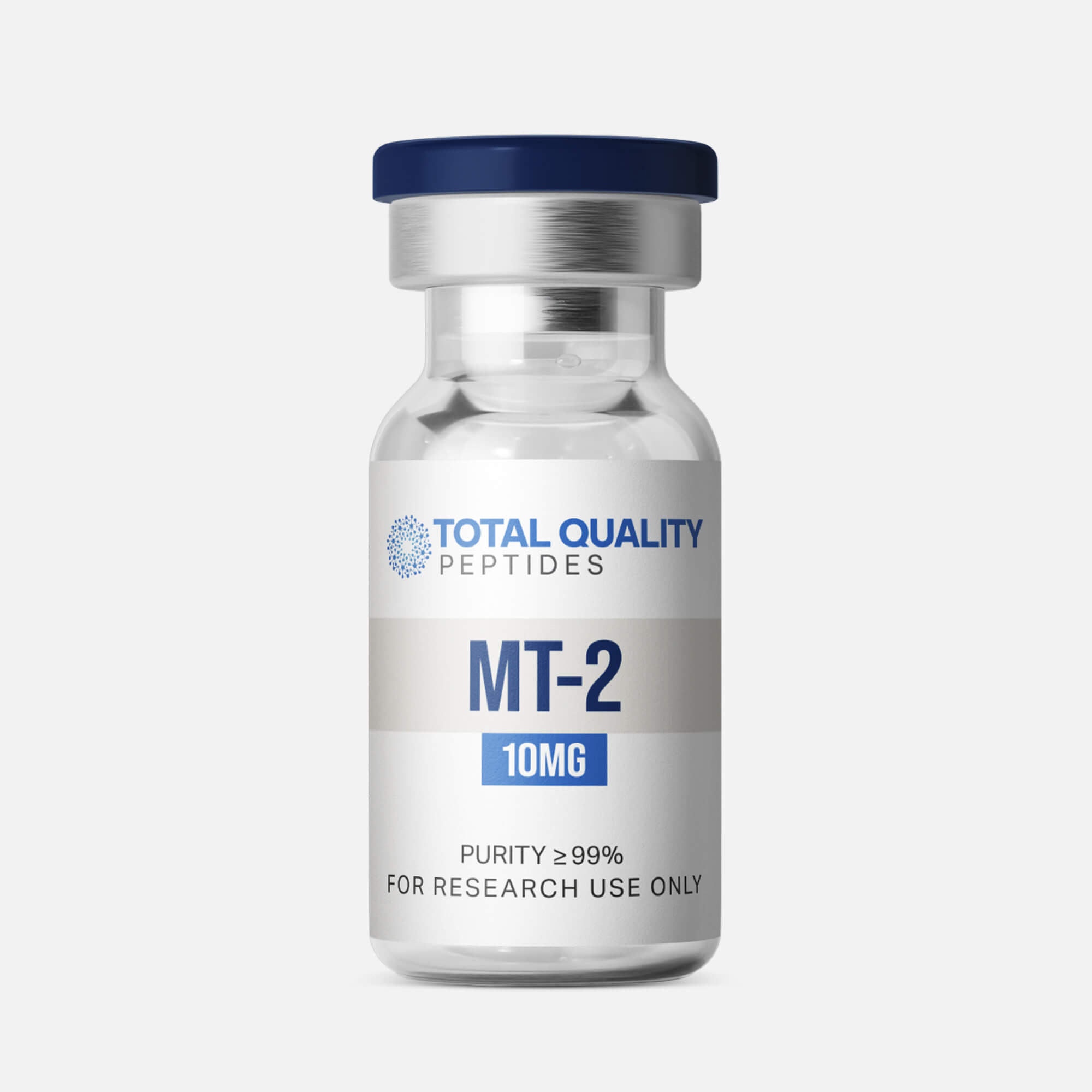
Product Specifications
- Peptide: Melanotan 2 (MT-II)
- Other Designations: Melanotan II, MT-2, MT-II
- Classification: Synthetic lab-made peptide; activates several body receptors instead of just one.
- Available Size: 10mg
- Form: Lyophilized (freeze-dried) powder
- Purity: >99%
- Amino Acid Count: 7 (cyclic structure)
- Molecular Formula: C₅₀H₆₉N₁₅O₉
- Molecular Weight: 1024.19 g/mol
- Receptor Targets: MC1R, MC3R, MC4R, MC5R (four of five melanocortin receptor subtypes)
- Endogenous Analog: α-Melanocyte-Stimulating Hormone (α-MSH)
- Origin: Wholly synthetic — designed as a modified, cyclized analog of the naturally occurring α-MSH peptide
- Storage: Store lyophilized powder at -20°C. Once reconstituted, store at 2–8°C and use within 30 days.
- Intended Use: For research in labs only. Not for use by people or animals.
- Third-party tested with Certificate of Analysis available.
What Is Melanotan 2?
Melanotan 2 (MT-II) is a synthetic cyclic heptapeptide—a ring composed of seven amino acids. It was designed as a modified analog of α-melanocyte-stimulating hormone (α-MSH), one of the body’s natural melanocortin signaling peptides. Unlike peptides that target a single receptor and produce one primary effect, Melanotan 2 acts on four of the five melanocortin receptor subtypes simultaneously. Each receptor is located in different tissues and regulates distinct biological processes, resulting in a range of effects when activated.
This non-selective, multi-receptor profile means a single peptide can trigger signaling cascades in several areas: the skin (melanogenesis), the central nervous system (arousal and appetite), peripheral tissues (glandular modulation), and neural circuits involved in social behavior. Few peptides in the research space engage as many receptors with such a compact, seven-amino-acid structure.
The cyclic architecture of Melanotan 2 is a deliberate design choice. By cyclizing the peptide backbone—forming a ring rather than leaving it linear—the developers increased the compound’s metabolic stability, extended its duration of activity relative to linear α-MSH, and modified its receptor-binding profile to engage multiple melanocortin receptor subtypes with enhanced affinity.
The four receptors that Melanotan 2 is thought to activate are:
MC1R (Melanocortin 1 Receptor) — Expressed primarily on melanocytes, the pigment-producing cells found in the skin, hair follicles, and ocular tissues. Activation of MC1R is associated with increased eumelanin production, the dark pigment responsible for skin and hair pigmentation. This receptor is the primary target associated with Melanotan 2’s pigmentation research applications.
MC3R (Melanocortin 3 Receptor) — Found in a range of tissues, including the brain and placenta. MC3R has been implicated in modulating appetite and energy homeostasis under experimental conditions. Its role is less well characterized than that of MC1R or MC4R, but it remains an active area of metabolic research.
MC4R (Melanocortin 4 Receptor) — Expressed in the central nervous system, primarily in the hypothalamus. MC4R activation is linked to arousal, mating signals, and appetite regulation. Research suggests that MC4R may influence dopamine and oxytocin pathways, connecting melanocortin signaling to neural networks involved in motivation and social behavior.
MC5R (Melanocortin 5 Receptor) — Distributed across multiple tissues, including exocrine glands. The specific physiological role of MC5R remains under investigation, though it may modulate peripheral glandular function, linking central melanocortin signaling with peripheral tissue responses.
How Melanotan 2 Works: Proposed Mechanisms of Action
Melanotan 2’s multiple effects. Because Melanotan 2 acts on different receptors, it can produce different effects depending on which receptors it activates. a MC1R: When Melanotan 2 binds MC1R on melanocytes, it’s proposed to trigger a chain reaction that leads to increased eumelanin production. Eumelanin is the pigment for skin and hair darkening. The proposed steps include MC1R activation, adenylate cyclase stimulation, cAMP production, protein kinase A (PKA) activation, MITF phosphorylation, and upregulation of tyrosinase in the melanin pathway. This process may boost eumelanin production in the absence of UV exposure. That’s why Melanotan 2 is studied in pigmentation research.
Arousal Neurosignaling via MC4R. MC4R activation in the hypothalamus is proposed to initiate supraspinal signaling cascades that influence arousal-related neural circuits. These signals may be transmitted to sympathetic and parasympathetic centers in the spinal cord and thoracolumbar region. The downstream signaling pathways are believed to involve dopaminergic and oxytocinergic neuromodulators, connecting melanocortin receptor activation to established neurotransmitter systems that regulate motivation, reward, and reproductive behavior. Clinical research has reported that Melanotan 2 induced increased arousal-related neurosignaling in over 80% of subjects, compared with approximately 20% with placebo.
Oxytocinergic modulation via MC4R: Melanotan 2 may stimulate oxytocin release by acting on MC4R-responsive brain cells, particularly in the paraventricular nucleus. This oxytocin can affect how the brain uses serotonin, glutamate, dopamine, and GABA. These neurotransmitters help shape social thinking, emotions, and behavior. By engaging them, Melanotan 2 may change how brain networks communicate and adapt.
Neuroprotection via MC4R. Melanotan 2’s interaction with MC4R has been proposed to extend beyond behavioral modulation into direct neuroprotective and neurotrophic activity. The peptide is believed to promote neurite outgrowth — the extension of neuronal processes — and to support the intrinsic capacity of neuronal tissue to recover after injury. This neuroprotective pathway is thought to be mediated through the pro-opiomelanocortin (POMC)-derived melanocortin signaling system, which may influence neuronal structure by increasing the number and length of neurites and potentially promoting nerve sprouting in damaged regions.
Preclinical and Clinical Research Overview
Melanotan 2 has been studied across a diverse range of research domains. Below is a detailed summary organized by focus area.
Melanotan 2 and Pigmentation / Melanogenesis
The most widely known research application of Melanotan 2 involves its potential to stimulate melanin production in the absence of ultraviolet radiation.
By engaging MC1R on melanocytes, Melanotan 2 is proposed to increase eumelanin synthesis through the cAMP/PKA/MITF signaling cascade. Clinical research has reported observable darkening of skin pigmentation in experimental subjects, with researchers documenting increased pigmentation across multiple body regions, including the face, upper body, and other areas, in controlled settings.
The peptide’s cyclic structure confers a longer-lasting effect than that of linear α-MSH analogs. This means MC1R is engaged for a longer time with each exposure. The result is a stronger, longer-lasting melanogenic effect compared to the endogenous hormone.
This UV-independent research on the color-boosting effect of Melanotan 2, which does not require sunlight, has made Melanotan 2 a key tool for studying how skin darkens and how pigment is regulated in the body.nd Nerve Regeneration / Neuroprotection
An area of Melanotan 2 research that extends well beyond its pigmentation applications is its potential neurotrophic and neuroprotective properties.
In a murine model of induced peripheral nerve injury, Melanotan 2 was presented to half of the experimental group. Within 48 hours, the Melanotan 2 subjects appeared to have recovered sensory function — a notably rapid timeline for peripheral nerve regeneration. The proposed mechanism involves MC4R-mediated signaling that promotes neurite outgrowth and supports the intrinsic regenerative capacity of neuronal tissue.
In another part of the study, mice given a chemotherapy drug (cisplatin) also received Melanotan 2. These mice appeared to be partially protected against nerve damage by the drug. Researchers concluded that the peptide may offer nerve protection and support regeneration.
These results make Melanotan 2 an interesting candidate for nerve regeneration and research on chemotherapy-induced neuropathy. These studies are different from their roles in pigmentation or arousal. They come from the same MC4R engagement that causes those other effects.
Melanotan 2 and Arousal Neurosignaling
Clinical research has investigated Melanotan 2’s effects on arousal-related neural signaling, demonstrating the peptide’s potency at MC4R.
In a controlled clinical study, Melanotan 2 was reported to induce increased arousal neurosignaling in more than 80% of subjects, compared to only approximately 20% with placebo — a response differential that underscores the peptide’s potency at the MC4R target.
The proposed mechanism involves MC4R activation in hypothalamic centers followed by downstream engagement of dopaminergic and oxytocinergic signaling pathways. These neuromodulatory systems are believed to coordinate homeostatic and motivational behaviors, and the introduction of a potent MC4R agonist like Melanotan 2 may reframe the balance of neuronal activity within these circuits.
Researchers have also proposed that MC5R engagement in peripheral glands may provide a parallel signaling route that links central arousal neurosignaling with peripheral modulatory factors — though this remains a hypothesis requiring further mechanistic investigation.
Melanotan 2 and Neurodevelopmental Modulation
One of the most novel areas of Melanotan 2 research examines its potential to influence social cognition through MC4R-mediated oxytocinergic signaling.
Researchers have proposed that Melanotan 2 may stimulate endogenous oxytocin release from MC4R-sensitive neurons in the paraventricular nucleus of the hypothalamus. This oxytocin release is hypothesized to modulate neurotransmission across serotonin, glutamate, dopamine, and GABA systems — the four major neurotransmitter pathways implicated in social adaptation, emotional regulation, and behavioral flexibility.
By engaging these systems simultaneously, Melanotan 2 may alter the functional connectivity of cortical and subcortical networks — including regions such as the anterior cingulate cortex — where oxytocin receptor distribution may differ in atypical neurodevelopmental contexts. Researchers have hypothesized that this multi-system modulation might restore or modify synaptic communication and synaptic plasticity, potentially reshaping underlying neural architecture in models of impaired social cognition.
In animal models, Melanotan 2 was reported to reverse features associated with immune-activation-induced neurodevelopmental alterations, suggesting that MC4R-mediated oxytocin release may recalibrate imbalanced neurochemical activity underlying social impairment. This finding represents one of the most mechanistically sophisticated applications of any melanocortin receptor agonist studied to date.
Melanotan 2 and Its Relationship to Related Melanocortin Peptides
Understanding where Melanotan 2 sits within the broader family of melanocortin receptor agonists helps researchers select the appropriate compound for their experimental design.
α-MSH (Alpha-Melanocyte-Stimulating Hormone) — The endogenous linear peptide that Melanotan 2 was designed to mimic. α-MSH is a 13-amino-acid peptide derived from proopiomelanocortin (POMC) that activates melanocortin receptors as part of normal physiological signaling. Its linear structure results in rapid enzymatic degradation and a short functional half-life.
Melanotan 1 (Afamelanotide / MT-I) — A linear 13-amino-acid analog of α-MSH that is more selective for MC1R than Melanotan 2. Melanotan 1 has been studied primarily for pigmentation applications and has received regulatory approval in some jurisdictions for specific photodermatological conditions. Because it is more MC1R-selective, it produces a narrower range of effects than the multi-receptor agonist Melanotan 2.
Melanotan 2 (MT-II) — A cyclic 7-amino-acid analog with non-selective affinity across MC1R, MC3R, MC4R, and MC5R. Its cyclic structure provides enhanced metabolic stability and prolonged activity compared to linear analogs. The multi-receptor profile produces a broader range of biological effects spanning pigmentation, arousal, appetite, neuroprotection, and social cognition — making it the most pharmacologically diverse compound in the melanocortin agonist family.
PT-141 (Bremelanotide) — A metabolite of Melanotan 2 that acts primarily on MC3R and MC4R without significant MC1R activity. PT-141 has been developed specifically for arousal-related research and has achieved FDA approval for a specific clinical indication. Because it lacks MC1R affinity, it does not produce melanogenic (pigmentation) effects, separating the arousal signaling component from the pigmentation component that Melanotan 2 simultaneously activates.
The choice between these compounds depends on the research question. MC1R-focused pigmentation studies favor Melanotan 1. MC4R-focused arousal or neuroprotection studies may use either Melanotan 2 or PT-141. Multi-receptor studies requiring simultaneous engagement of MC1R, MC3R, MC4R, and MC5R require Melanotan 2 specifically — it is the only compound in the family with this breadth of receptor coverage.
Summary of Key Research Findings
- Receptor Profile — Non-selective agonist at MC1R, MC3R, MC4R, and MC5R; the broadest melanocortin receptor coverage of any available research peptide
- Melanogenesis — Stimulates eumelanin production via MC1R → cAMP/PKA/MITF pathway; observable skin darkening reported in clinical settings without UV exposure
- Nerve Regeneration — Sensory function recovery within 48 hours in the peripheral nerve injury model; MC4R-mediated neurite outgrowth promotion
- Neuroprotection — Partial protection against cisplatin-induced peripheral neurotoxicity in animal models
- Arousal Neurosignaling — Over 80% response rate in clinical study (vs ~20% placebo); MC4R-mediated activation of dopaminergic and oxytocinergic pathways
- Neurodevelopmental Modulation — MC4R-mediated oxytocin release is proposed to modulate serotonin, glutamate, dopamine, and GABA neurotransmission; it reverses immune-activation-induced social impairment features in animal models.
- Cyclic Structure — Enhanced metabolic stability and prolonged metabotropic activity compared to linear α-MSH analogs
- Related Compounds — Parent analog of PT-141 (Bremelanotide); more receptor-diverse than both Melanotan 1 and PT-141
Handling and Reconstitution
- Store lyophilized powder at -20°C for long-term stability.
- Reconstitute with bacteriostatic water or sterile water for injection.
- Once reconstituted, store at 2–8°C (refrigerator temperature)
- Use the reconstituted solution within 30 days.
- Avoid repeated freeze-thaw cycles.
- Protect from light during storage and handling — melanocortin peptides may be light-sensitive.
- Handle with appropriate laboratory safety protocols.
Quality Assurance
- Purity verified at >99% by high-performance liquid chromatography (HPLC)
- Identity confirmed by mass spectrometry (MS)
- Certificate of Analysis (COA) available for every batch
- Third-party tested for purity, identity, and consistency.
- Supplied as lyophilized (freeze-dried) powder for maximum stability
Frequently Asked Questions
What is Melanotan 2?
Melanotan 2 (MT-II) is a synthetic cyclic heptapeptide — a seven-amino-acid ring-structured analog of α-melanocyte-stimulating hormone (α-MSH). It acts as a non-selective agonist across four of the five melanocortin receptor subtypes (MC1R, MC3R, MC4R, MC5R), producing a broad range of biological effects spanning pigmentation, arousal neurosignaling, neuroprotection, and modulation of social cognition.
How does Melanotan 2 differ from Melanotan 1?
Melanotan 1 is a linear 13-amino-acid α-MSH analog that is more selective for MC1R, primarily producing pigmentation effects. Melanotan 2 is a cyclic 7-amino-acid structure with non-selective affinity across MC1R, MC3R, MC4R, and MC5R — producing a broader range of effects, including pigmentation, arousal, neuroprotection, and social cognition modulation. Melanotan 2’s cyclic structure also provides greater metabolic stability and prolonged activity.
How does Melanotan 2 relate to PT-141 (Bremelanotide)?
PT-141 is a metabolite of Melanotan 2 that primarily activates MC3R and MC4R without significant MC1R activity. PT-141 has been developed for arousal-focused research and does not produce pigmentation effects. Melanotan 2 activates all four receptor subtypes simultaneously, including MC1R-mediated pigmentation, MC4R-mediated arousal, and neuroprotective signaling.
What is the cyclic structure, and why does it matter?
Melanotan 2’s amino acid chain is connected into a ring (cyclized) rather than left as a linear chain. This cyclic architecture increases metabolic stability, extends the duration of receptor engagement, and enhances binding affinity compared to linear α-MSH analogs — making Melanotan 2 more potent and longer-lasting than the endogenous hormone it mimics.
What neuroprotective properties has Melanotan 2 shown?
In animal models, Melanotan 2 promoted sensory function recovery within 48 hours of peripheral nerve injury and partially protected peripheral nerves from cisplatin-induced neurotoxicity. These effects are proposed to be mediated through MC4R, which may promote neurite outgrowth and support neuronal regenerative capacity.
What was the arousal response rate in clinical research?
Over 80% of subjects exhibited increased arousal neurosignaling with Melanotan 2, compared to approximately 20% with placebo.
What is the purity of this product?
Greater than 99%, verified by third-party HPLC and mass spectrometry. A Certificate of Analysis is available for every batch.
What size is available?
10mg.
How should I store this product?
Store lyophilized powder at -20°C. Once reconstituted, store at 2–8°C and use within 30 days. Protect from light. Avoid repeated freeze-thaw cycles.
What is this product intended for?
This product is intended for laboratory and research purposes only. It is not intended for human consumption, therapeutic use, or diagnostic purposes.
References
- Ryakhovsky, V. V., et al. (2008). The first preparative solution phase synthesis of Melanotan II. Beilstein Journal of Organic Chemistry, 4, 39. https://doi.org/10.3762/bjoc.4.39
- Hadley, M. E. (2005). The discovery that a melanocortin regulates sexual functions in male and female humans. Peptides, 26(10), 1687–1689. https://doi.org/10.1016/j.peptides.2005.01.023
- King, S. H., et al. (2007). Melanocortin receptors, melanotropic peptides, and penile erection. Current Topics in Medicinal Chemistry, 7(11), 1098–1106. https://www.ncbi.nlm.nih.gov/pmc/articles/PMC2694735/
- Peters, B., et al. (2020). Melanotan II: a possible cause of renal infarction: review of the literature and case report. CEN Case Reports, 9(2), 159–161. https://doi.org/10.1007/s13730-020-00447-z
- Ter Laak, M. P., et al. (2003). The potent melanocortin receptor agonist melanotan-II promotes peripheral nerve regeneration and has neuroprotective properties in the rat. European Journal of Pharmacology, 462(1–3), 179–183. https://doi.org/10.1016/s0014-2999(02)02945-x
- Wessells, H., et al. (2000). Melanocortin receptor agonists, penile erection, and sexual motivation: human studies with Melanotan II. International Journal of Impotence Research, 12(Suppl 4), S74–S79. https://doi.org/10.1038/sj.ijir.3900582
- Minakova, E., et al. (2019). Melanotan-II reverses autistic features in a maternal immune activation mouse model of autism. PLoS ONE, 14(1), e0210389. https://doi.org/10.1371/journal.pone.0210389
- Dorr, R. T., et al. (1996). Evaluation of melanotan-II, a superpotent cyclic melanotropic peptide in a pilot phase-I clinical study. Life Sciences, 58(20), 1777–1784. https://doi.org/10.1016/0024-3205(96)00160-9
Disclaimer
This product is sold for research and laboratory use only. It is not a drug, food, cosmetic, or supplement. It is not intended to diagnose, treat, cure, or prevent any disease or medical condition. It is not approved for human or veterinary use. The information provided on this page is drawn from published preclinical and clinical research literature and is presented for informational purposes only. Researchers are responsible for ensuring compliance with all applicable regulations governing the purchase, handling, and use of research peptides in their jurisdiction.
All products sold by TQ Peptides are intended strictly for laboratory research, analytical testing, and in vitro experimental purposes only. These products are not intended for human or animal consumption.
TQ Peptides operates solely as a research chemical supplier and is not a compounding pharmacy or chemical compounding facility as defined under Section 503A of the Federal Food, Drug, and Cosmetic Act. Additionally, TQ Peptides is not classified as an outsourcing facility under Section 503B of the same Act.
The statements made on this website have not been evaluated by the U.S. Food and Drug Administration (FDA). Products sold by TQ Peptides are not intended to diagnose, treat, cure, or prevent any disease.