Product Specifications
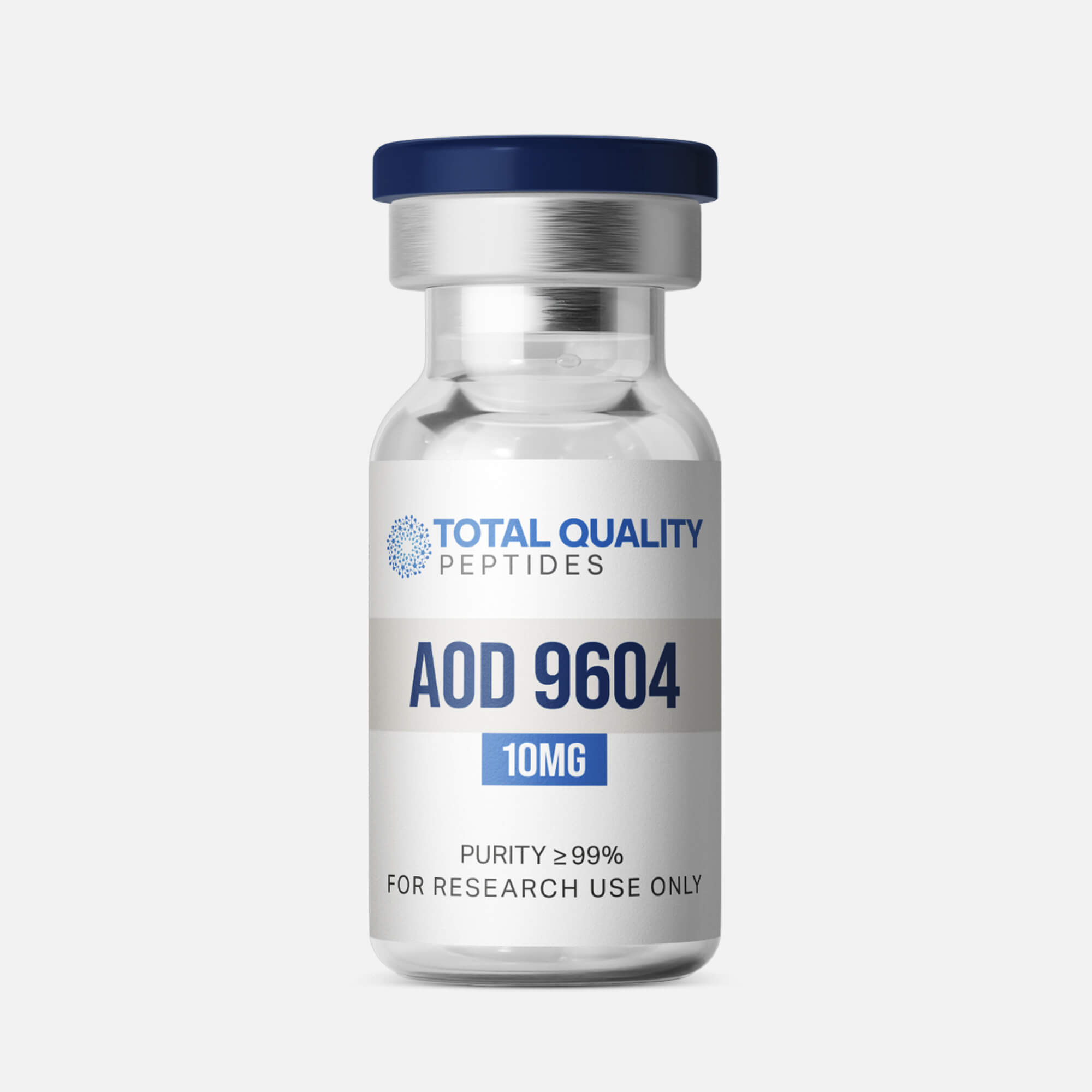
- Peptide: AOD 9604
- Other Designations: Tyr-hGH Fragment 177-191, hGH Fragment 176-191 (modified), Anti-Obesity Drug 9604
- Classification: Modified lipolytic fragment of human growth hormone
- Available Sizes: 10mg
- Form: Lyophilized (freeze-dried) powder
- Purity: >99%
- Amino Acid Count: 16 (residues 176-191 of hGH with N-terminal tyrosine substitution)
- Molecular Formula: C₇₈H₁₂₃N₂₃O₂₃S₂
- Molecular Weight: 1815.12 g/mol
- Origin: Wholly synthetic — modified fragment derived from the C-terminal region of human growth hormone
- Storage: Store lyophilized powder at -20°C. Once reconstituted, store at 2–8°C and use within 30 days.
- Intended Use: For laboratory and research purposes only. Not for human consumption.
- Third-party tested with Certificate of Analysis available.
What Is AOD 9604?
AOD 9604, designated Anti-Obesity Drug 9604, is a synthetic peptide of 16 amino acids replicating a modified C-terminal segment of human growth hormone (hGH). It is composed of residues 176–191, with a tyrosine substitution at the N-terminus to enhance peptide stability. These features make it a subject of interest for isolating the structure-function relationship of this hGH region.
Development of AOD 9604 in the 1990s was driven by research demonstrating regional specificity within the 191-amino-acid hGH molecule. Researchers identified the N-terminal region with insulin-potentiating activity, the mid-region with mitogenic responses, and the C-terminal region, replicated by AOD 9604, with lipolytic function. This informed subsequent experimental delineation of hGH fragment-based activities.
By isolating and modifying this specific fragment, researchers created a peptide designed to investigate the fat metabolism properties of growth hormone in isolation — separated from the insulin-like, mitogenic, and growth-promoting activities associated with other regions of the full molecule. This distinct focus allows researchers to study fat metabolism without the confounding effects of growth or insulin-related pathways. The unique selling point of AOD 9604 is its specificity: it is proposed to stimulate lipolysis without stimulating insulin-like growth factor 1 (IGF-1) production, unlike full-length growth hormone, which affects multiple biological processes simultaneously.
AOD 9604 is supplied as a lyophilized powder at greater than 99% purity, verified by third-party HPLC and mass spectrometry analysis.
How AOD 9604 Works — Proposed Mechanism of Action
AOD 9604 may promote fat breakdown in the body through several biological pathways, as shown in preclinical studies. Key actions are described below:
AOD 9604 may increase beta-3 adrenergic receptors (β₃-AR) on fat cells, supporting fat breakdown, especially in obese animals.
Even in models without beta-3 receptors, AOD 9604 promoted fat breakdown. This suggests it may boost energy use and fat burning through other, still unclear, mechanisms.
Unlike full growth hormone, AOD 9604 does not seem to stimulate IGF-1, allowing fat breakdown studies without affecting growth or insulin pathways.
AOD 9604 may both promote fat breakdown and inhibit fat synthesis, positioning it as a research tool for studying both fat loss and prevention.
Preclinical and Clinical Research Overview
AOD 9604 has been investigated across preclinical animal models and human clinical trials. Below is a detailed summary organized by research domain.
AOD 9604 and Lipolytic Activity
The foundational research on AOD 9604’s potential to modulate fat metabolism was conducted in obese murine models.
Obese mice given AOD 9604 for 14 days showed reduced body weight and fat, correlated with increased β₃-adrenergic receptors in fat tissue, suggesting restored lipolytic receptor expression.
Experiments in β₃-AR knockout mice showed that AOD 9604 maintained lipolytic activity by increasing energy expenditure and fat oxidation, indicating activity via multiple pathways.
In obese Zucker rats, daily AOD 9604 for 19 days reduced weight by over 50% compared to placebo, with increased fat breakdown and no significant change in insulin sensitivity, supporting modulation of fat metabolism without disturbing glucose balance.
AOD 9604 and Clinical Obesity Research
The preclinical lipolytic findings led to human clinical trials investigating AOD 9604’s potential in clinical obesity management.
A 2004 trial with 300 obese subjects showed steady weight loss over 12 weeks with AOD 9604, along with minor improvements in cholesterol and glucose tolerance.
Though weight loss was modest, sustained effects and improved metabolic markers make AOD 9604 a continued research interest for metabolic studies.
AOD 9604 and Cartilage / Cell Regeneration
An area of AOD 9604 research that extends beyond its originally intended lipolytic application examines the peptide’s potential role in tissue regeneration — specifically cartilage repair and cellular differentiation.
A 2015 study in rabbits found the combination of AOD 9604 and hyaluronic acid produced the least cartilage degeneration, suggesting AOD 9604 may enhance cartilage repair.
Separate in vitro research has provided a mechanistic context for these regenerative findings:
- Adipose mesenchymal stem cell differentiation — AOD 9604 appeared to enhance the differentiation of adipose-derived mesenchymal stem cells (found within fat tissue) into bone cells, suggesting a role in osteogenic processes.
- Chondrocyte stimulation — When tested on isolated bovine chondrocytes (the cells responsible for producing and maintaining cartilage matrix), AOD 9604 appeared to increase the production of both proteoglycan and collagen — the two primary structural components of cartilage tissue.
- Myoblast differentiation — The peptide appeared to promote the differentiation of myoblast precursor cells into more mature muscle cell forms (C2C12 cell line), suggesting potential relevance to muscle tissue repair as well.
These results suggest AOD 9604 has potential for dual research application: elucidating lipolytic processes in adipose tissue and evaluating regenerative effects in bone, cartilage, and muscle—making it a versatile peptide for investigators examining structure-activity relationships in hGH-derived sequences.
AOD 9604 and Cancer Cell Research
An emerging line of AOD 9604 research examines its potential interaction with tumor cell biology — specifically its ability to enhance the efficacy of established chemotherapeutic agents.
In one study, researchers utilized chitosan nanoparticles — a biocompatible, biodegradable polymer carrier — loaded with both doxorubicin (a widely recognized chemotherapeutic agent) and AOD 9604. The investigators hypothesized that AOD 9604 might bind to tumor-related proteins, potentially enhancing drug accumulation within tumor cells and increasing local cytotoxicity.
The results supported this hypothesis. When tested against the MCF-7 breast cancer cell line, the combination of doxorubicin and AOD 9604 loaded in chitosan nanoparticles appeared to exhibit greater anti-proliferative activity compared to chitosan loaded with doxorubicin alone. This finding suggested that AOD 9604 may augment the anticancer potency of doxorubicin, while the nanoparticle delivery system minimized exposure to non-target tissues.
While this research is preliminary and specific to one cancer cell line and one delivery system, it opens an unexpected avenue for a peptide originally developed for metabolic research. The ability to potentially enhance chemotherapeutic drug targeting and tumor-cell-specific accumulation could position AOD 9604 as a compound of interest in combinatorial oncological research.
AOD 9604 and Its Relationship to Fragment 176-191
Researchers and buyers sometimes encounter both “AOD 9604” and “Fragment 176-191” in the peptide literature and marketplace. Understanding the relationship between these two designations is important for accurate experimental design.
Both compounds correspond to the same C-terminal region of human growth hormone, residues 176-191. The key difference is structural: AOD 9604 includes a tyrosine substitution at the N-terminus (replacing the original amino acid at position 176) to enhance the peptide’s stability. Fragment 176-191, in its unmodified form, reproduces the native hGH sequence without this substitution.
In practical terms, AOD 9604 is the stabilized, modified version of Fragment 176-191. Research publications may reference either designation depending on which specific compound was used in the study, so investigators should verify which form is being discussed when reviewing the literature.
5mg vs 10mg — Choosing the Right Size
Both sizes contain the same AOD 9604 peptide at >99% purity. The choice between 5mg and 10mg is a matter of research protocol requirements:
- 5mg — Suited for shorter-duration studies, pilot investigations, initial dose-response assessments, or research protocols with lower total peptide requirements. The smaller vial also offers a lower entry point for researchers evaluating the compound for the first time.
- 10mg — Provides greater flexibility for extended study durations, higher-concentration reconstitution protocols, or research designs requiring multiple administrations from a single vial. More cost-efficient per milligram for researchers who have already validated their protocol and committed to a longer study timeline.
Both sizes are supplied as lyophilized powder in sealed research vials with full COA documentation.
Summary of Key Research Findings
- Lipolytic Activity — Reduced body weight and fat mass in obese murine models; restored β₃-adrenergic receptor expression in adipose tissue; lipolytic effects persisted even in β₃-AR knockout models through increased energy expenditure and fat oxidation
- Dual Mechanism — Appears to both promote lipolysis (fat breakdown) and inhibit lipogenesis (fat synthesis)
- IGF-1 Independence — Stimulates fat metabolism without triggering IGF-1 production — isolating the lipolytic effects of hGH from its growth and insulin-sensitizing activities
- Insulin Sensitivity — No marked disruption of insulin sensitivity observed in preclinical models; improved glucose tolerance noted in clinical trials
- Clinical Obesity — 12-week trial in 300 obese subjects showed consistent weight loss, improved cholesterol profiles, and improved glucose tolerance
- Cartilage Regeneration — AOD 9604 + hyaluronic acid combination exhibited the least cartilage degeneration in the rabbit osteoarthritis model; enhanced chondrocyte proteoglycan and collagen production in vitro
- Stem Cell Differentiation — Enhanced differentiation of adipose mesenchymal stem cells into bone cells; promoted myoblast differentiation into mature muscle cell forms
- Cancer Research — Enhanced anti-proliferative activity of doxorubicin-loaded chitosan nanoparticles against MCF-7 breast cancer cells
Handling and Reconstitution
- Store lyophilized powder at -20°C for long-term stability.
- Reconstitute with bacteriostatic water or sterile water for injection.
- Once reconstituted, store at 2–8°C (refrigerator temperature)
- Use the reconstituted solution within 30 days.
- Avoid repeated freeze-thaw cycles.
- The tyrosine substitution at the N-terminus is intended to enhance stability, but standard peptide-handling protocols should still be observed.
- Handle with appropriate laboratory safety protocols.
Quality Assurance
- Purity verified at >99% by high-performance liquid chromatography (HPLC)
- Identity confirmed by mass spectrometry (MS)
- Certificate of Analysis (COA) available for every batch
- Third-party tested for purity, identity, and consistency.
- Supplied as lyophilized (freeze-dried) powder for maximum stability
Frequently Asked Questions
What is AOD 9604?
AOD 9604 (Anti-Obesity Drug 9604) is a synthetic peptide consisting of 16 amino acids corresponding to a modified version of the C-terminal fragment (residues 176–191) of human growth hormone. It includes a tyrosine substitution at the N-terminus for enhanced stability. It was developed in the 1990s to investigate the fat-metabolizing properties of growth hormone, independent of its growth-promoting, insulin-sensitizing, and mitogenic effects.
How does AOD 9604 differ from full-length growth hormone?
Full-length hGH is a 191-amino-acid protein that activates GH receptors, stimulates IGF-1 production, and exerts a wide range of effects, including growth promotion, insulin modulation, mitogenic activity, and lipolysis. AOD 9604 reproduces only the lipolytic region (residues 176–191) and does not appear to stimulate IGF-1 production, allowing researchers to study modulation of fat metabolism in isolation from other GH-mediated effects.
What is the difference between AOD 9604 and Fragment 176-191?
Both correspond to the same C-terminal region of hGH. AOD 9604 includes a tyrosine substitution at the N-terminus to enhance stability; Fragment 176-191 in its unmodified form reproduces the native sequence without this substitution. AOD 9604 is the stabilized, modified version.
Does AOD 9604 stimulate IGF-1?
No. Unlike full-length growth hormone, AOD 9604 does not appear to stimulate IGF-1 production. This dissociation of lipolytic activity from IGF-1-mediated growth effects is considered the peptide’s most significant pharmacological feature.
How does AOD 9604 promote fat loss in research models?
Through multiple proposed mechanisms: upregulation of β₃-adrenergic receptor expression in fat cells, increased energy expenditure, enhanced fat oxidation, and inhibition of lipogenesis (new fat synthesis). Studies in β₃-AR knockout models confirmed that the lipolytic effect is not dependent on a single receptor pathway.
Has AOD 9604 been tested in human clinical trials?
Yes. A 2004 clinical trial involving 300 obese subjects over 12 weeks reported consistent weight loss, minor improvements in cholesterol profiles, and improved glucose tolerance.
Does AOD 9604 affect insulin sensitivity?
Preclinical research reported no marked disruption of insulin sensitivity, and the clinical trial noted improved glucose tolerance, supporting the hypothesis that AOD 9604 can modulate fat metabolism without disrupting glucose homeostasis.
What regenerative research has been done with AOD 9604?
Studies have demonstrated potential for cartilage regeneration (especially when combined with hyaluronic acid), osteogenic differentiation of adipose stem cells, chondrocyte stimulation for collagen and proteoglycan production, and myoblast differentiation into mature muscle cells.
What sizes are available?
10mg
What is the purity of this product?
Greater than 99%, verified by third-party HPLC and mass spectrometry. A Certificate of Analysis is available for every batch in both sizes.
How should I store this product?
Store lyophilized powder at -20°C. Once reconstituted, store at 2–8°C and use within 30 days. Avoid repeated freeze-thaw cycles.
What is this product intended for?
This product is intended for laboratory and research purposes only. It is not intended for human consumption, therapeutic use, or diagnostic purposes.
References
- Heffernan, M., Summers, R. J., Thorburn, A., Ogru, E., Gianello, R., Jiang, W. J., & Ng, F. M. (2001). The Effects of Human GH and Its Lipolytic Fragment (AOD 9604) on Lipid Metabolism Following Chronic Treatment in Obese Mice and β₃-AR Knock-Out Mice. Endocrinology, 142(12), 5182–5189. https://doi.org/10.1210/endo.142.12.8522
- Moré, M. I., & Kenley, D. (2014). Safety and metabolism of AOD9604, a novel nutraceutical ingredient for improved metabolic health. Journal of Endocrinology and Metabolism, 4(3), 64–77.
- Ng, F. M., Sun, J., et al. (2000). Metabolic Studies of a Synthetic Lipolytic Domain (AOD 9604) of Human Growth Hormone. Hormone Research, February 2000.
- Medical and Life Sciences News. (2004). The obesity drug codenamed AOD 9604 is highly successful in trials. December 16, 2004.
- Kwon, D. R., & Park, G. Y. (2015). Effect of Intra-articular Injection of AOD9604 with or without Hyaluronic Acid in Rabbit Osteoarthritis Model. Annals of Clinical and Laboratory Science, 45(4), 426–434.
- Habibullah, M. M., Mohan, S., Syed, N. K., Makeen, H. A., Jamal, Q. M. S., Alothaid, H., Bantun, F., Alhazmi, A., Hakamy, A., Kaabi, Y. A., Samlan, G., Lohani, M., Thangavel, N., & Al-Kasim, M. A. (2022). Human Growth Hormone Fragment 176-191 Peptide Enhances the Toxicity of Doxorubicin-Loaded Chitosan Nanoparticles Against MCF-7 Breast Cancer Cells. Drug Design, Development and Therapy, 16, 1963–1974. https://doi.org/10.2147/DDDT.S367586
Disclaimer
This product is sold for research and laboratory use only. It is not a drug, food, cosmetic, or supplement. It is not intended to diagnose, treat, cure, or prevent any disease or medical condition. It is not approved for human or veterinary use. The information provided on this page is drawn from published preclinical and clinical research literature and is presented for informational purposes only. Researchers are responsible for ensuring compliance with all applicable regulations governing the purchase, handling, and use of research peptides in their jurisdiction.
All products sold by TQ Peptides are intended strictly for laboratory research, analytical testing, and in vitro experimental purposes only. These products are not intended for human or animal consumption.
TQ Peptides operates solely as a research chemical supplier and is not a compounding pharmacy or chemical compounding facility as defined under Section 503A of the Federal Food, Drug, and Cosmetic Act. Additionally, TQ Peptides is not classified as an outsourcing facility under Section 503B of the same Act.
The statements made on this website have not been evaluated by the U.S. Food and Drug Administration (FDA). Products sold by TQ Peptides are not intended to diagnose, treat, cure, or prevent any disease.