KLOW Peptide Blend – BPC-157 / GHK-Cu / TB-500 / KPV
Product Specifications
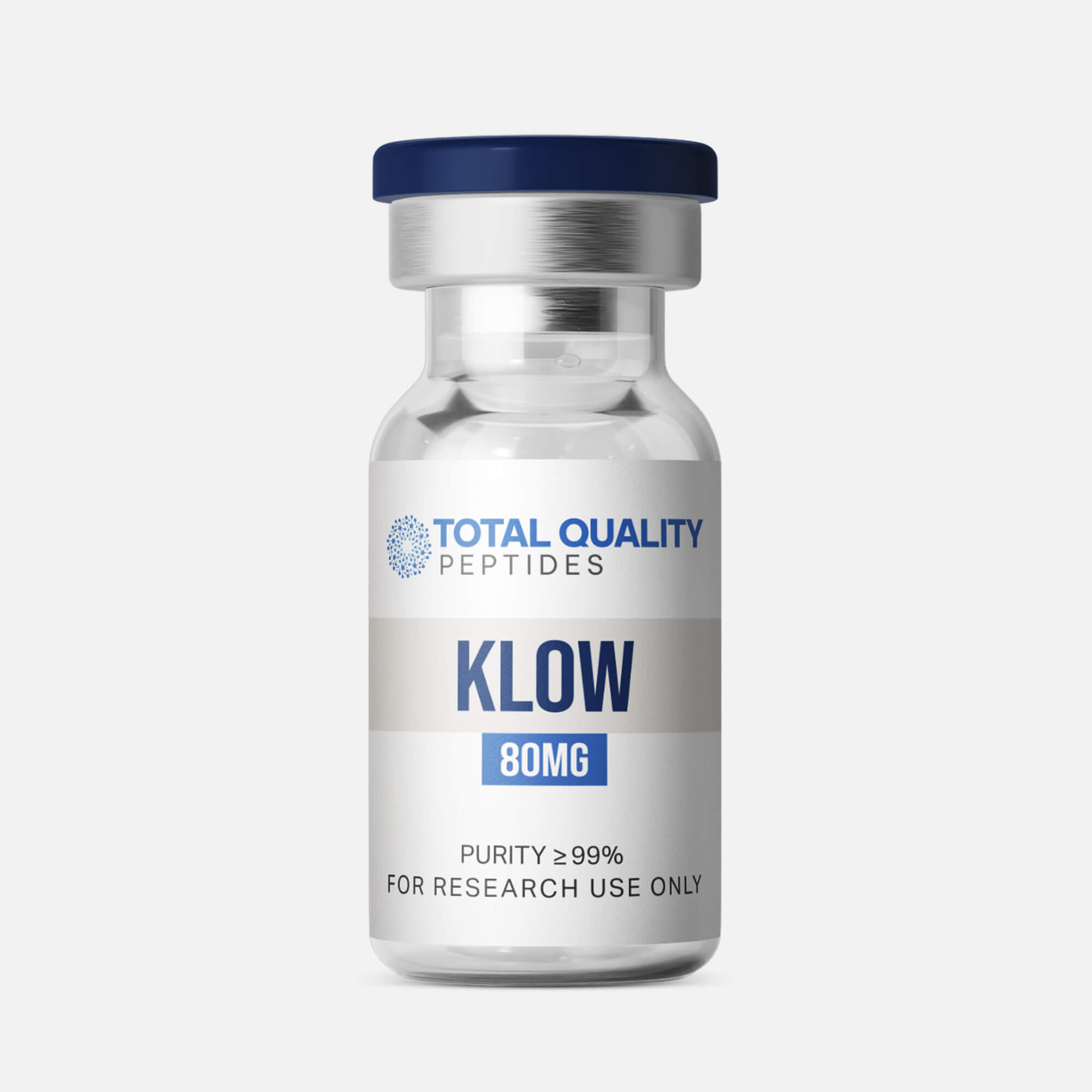
- Blend Name: KLOW
- Total Quantity: 80mg per vial
- Composition:
- BPC-157 – 10mg
- GHK-Cu – 50mg
- TB-500 (Thymosin Beta-4) – 10mg
- KPV – 10mg
- Form: Lyophilized (freeze-dried) powder
- Purity: 99%+ per component (HPLC certified)
- Appearance: White to off-white powder (may show faint blue tint from copper complex in GHK-Cu)
- Solubility: Soluble in sterile water and standard aqueous buffers
- Storage: Store at -20C. Protect from light and moisture. Stable for 24 months in lyophilized form.
- Third-Party Tested: Yes – Certificate of Analysis, HPLC, and Mass Spectrometry for each component
- For research use only. Not for human consumption.
Overview
KLOW is a multi-peptide research blend that combines four structurally distinct peptides into a single lyophilized preparation. Each component has been independently studied across decades of published research, and each operates through a different primary mechanism. The rationale for combining them in a single vial is to enable researchers to investigate multi-pathway interactions, synergistic effects, and combined signaling dynamics without the complexity of sourcing, reconstituting, and combining four separate peptides at the bench.
The four components span four distinct research domains:
BPC-157 (Body Protection Compound-157) is a 15-amino-acid synthetic peptide derived from a protein found in human gastric juice. It has been studied extensively in models of gastrointestinal mucosal protection, tendon and ligament repair, angiogenesis, and modulation of the nitric oxide system. BPC-157 represents the tissue-repair and gastroprotective pathways in the KLOW blend.
GHK-Cu (Glycyl-L-Histidyl-L-Lysine Copper Complex) is a naturally occurring copper-bound tripeptide found in human plasma, saliva, and urine. Research has focused on its role in extracellular matrix remodeling, collagen synthesis, wound healing, and the regulation of antioxidant enzymes. At 50mg – the largest component by mass in KLOW – GHK-Cu represents the copper-peptide signaling and tissue remodeling pathway.
TB-500 (Thymosin Beta-4) is a 43-amino-acid protein that plays a central role in actin polymerization and cell migration. Published research has examined its involvement in wound healing, cardiac tissue repair, angiogenesis, and anti-inflammatory signaling. TB-500 represents the cytoskeletal regulation and cellular migration pathway in the blend.
KPV (Lys-Pro-Val) is the C-terminal tripeptide fragment of alpha-melanocyte-stimulating hormone (alpha-MSH). Research has documented its anti-inflammatory properties, particularly in models of intestinal inflammation, where it has been shown to utilize the PepT1 transporter for targeted cellular uptake. KPV represents the anti-inflammatory and immune modulation pathway.
Component Research Summaries
BPC-157 (10mg)
BPC-157 has been the subject of over 100 published research papers since its initial characterization. The peptide’s primary research interests lie in its documented interactions with the nitric oxide (NO) system, its influence on growth factor expression, and its potential to accelerate tissue repair across multiple tissue types.
Key research findings include:
Sikiric et al. have published extensively on BPC-157’s gastroprotective effects, demonstrating in multiple studies that the peptide reduces gastric lesion formation and accelerates mucosal healing across various injury models. The research group has proposed that BPC-157 interacts with the NO system in a modulatory fashion – upregulating NO when it is depleted and downregulating it when it is excessive.
Chang et al. (2011) published in the Journal of Applied Physiology demonstrating that BPC-157 accelerated tendon-to-bone healing in a rat model, with improved biomechanical properties at the healing site compared to controls.
Hsieh et al. (2017) published research in Life Sciences showing that BPC-157 influences growth factor receptor expression, suggesting a mechanism by which the peptide may coordinate multiple tissue repair pathways simultaneously.
GHK-Cu (50mg)
GHK-Cu is unique among peptides in that its biological activity is mediated through both the peptide sequence and the bound copper ion. The copper complex was first identified by Dr. Loren Pickart in the 1970s, and subsequent research has documented a remarkably broad range of biological activities.
Key research findings include:
Pickart and Margolina (2018) published a comprehensive review documenting GHK-Cu’s ability to stimulate collagen synthesis, promote decorin production, and increase glycosaminoglycan synthesis – all critical components of extracellular matrix integrity and wound healing.
Canapp et al. (2003) reported that GHK-Cu accelerated wound healing and increased wound tensile strength in a canine model, with treated wounds showing improved collagen organization compared with controls.
Pollard et al. (2005) demonstrated GHK-Cu’s antioxidant properties, specifically its ability to upregulate superoxide dismutase (SOD) activity and reduce oxidative damage markers in tissue models.
Research has also documented GHK-Cu’s influence on gene expression, with Pickart et al. reporting that the copper peptide modulates the expression of over 4,000 genes – approximately 6% of the human genome – including genes involved in tissue repair, immune function, and antioxidant defense.
Key research findings include:
Goldstein et al. originally characterized Thymosin Beta-4 and identified its role in actin sequestration, establishing the protein as a key regulator of cellular motility and migration.
Sosne et al. (2002) published research in Experimental Eye Research demonstrating that Thymosin Beta-4 promoted corneal wound healing and reduced inflammation in ocular injury models.
Bock-Marquette et al. (2004) published a landmark study in Nature demonstrating that Thymosin Beta-4 promoted cardiac cell survival following experimental myocardial infarction in murine models, suggesting a role in cardiac tissue protection.
Smart et al. (2007) published in Nature, demonstrating that Thymosin Beta-4 activated epicardial progenitor cells capable of differentiating into cardiac tissue, expanding the potential applications of TB-500 research into regenerative medicine.
Regulatory status: TB-500 was removed from FDA Category 2 on April 15, 2026, and is scheduled for PCAC Category 1 review on July 23, 2026.
KPV (10mg)
KPV is the smallest component in the KLOW blend by molecular weight (342.43 g/mol) but has generated significant research interest for its potent anti-inflammatory activity at nanomolar concentrations.
Key research findings include:
Dalmasso et al. (2008) published in Gastroenterology, demonstrating that KPV reduced intestinal inflammation through PepT1-mediated cellular uptake, establishing a mechanism for targeted anti-inflammatory delivery to intestinal tissue.
Kannengiesser et al. (2008) reported that KPV administration led to accelerated recovery and reduced inflammatory infiltrates in two distinct murine models of inflammatory bowel disease.
Hiltz and Lipton (1989) originally identified KPV as the minimum active fragment of alpha-MSH responsible for the parent hormone’s anti-inflammatory properties, establishing the foundation for all subsequent KPV research.
Regulatory status: KPV was removed from FDA Category 2 on April 15, 2026, and is scheduled for PCAC Category 1 review on July 23, 2026.
The Multi-Peptide Research Rationale
The value of a pre-blended multi-peptide preparation like KLOW for research lies in the ability to investigate interactions between distinct signaling pathways in a standardized, reproducible format.
Each component in KLOW operates through a different primary mechanism:
- BPC-157: Nitric oxide system modulation, growth factor expression, gastroprotection
- GHK-Cu: Copper-mediated extracellular matrix remodeling, gene expression modulation, and antioxidant enzyme upregulation
- TB-500: Actin polymerization regulation, cell migration, angiogenesis
- KPV: Serotonin reuptake-independent anti-inflammatory activity, NF-kB pathway inhibition, PepT1-mediated intestinal targeting
These pathways have minimal mechanistic overlap, which makes the blend suitable for studying additive or synergistic effects across concurrent biological processes – tissue repair, matrix remodeling, cellular migration, and inflammation resolution occurring simultaneously rather than sequentially.
The pre-blended format also eliminates a common source of experimental variability: the manual combination of multiple peptides at the point of use. Each KLOW vial contains a fixed, verified ratio of all four components, ensuring consistent experimental conditions across replicates.
Storage and Handling
- Store lyophilized powder at -20C (freezer)
- Protect from light, heat, and moisture.
- Reconstituted solutions should be stored at 2-8C and used promptly.
- Avoid repeated freeze-thaw cycles – aliquot reconstituted material if multiple uses are planned.
- The GHK-Cu component may impart a faint blue tint to the reconstituted solution; this is normal and indicates the presence of the copper complex.
- Maintain aseptic technique during all handling.
- Stable for 24 months in lyophilized form when stored at the recommended temperature
Why TQ Peptides?
- 99%+ purity on every component in the blend
- Full analytical documentation: COA, HPLC, and Mass Spectrometry for each peptide
- Fast shipping on all orders
Chemical Information by Component
BPC-157
- Molecular Formula: C62H98N16O22
- Molecular Weight: 1419.5 g/mol
- Sequence: Gly-Glu-Pro-Pro-Pro-Gly-Lys-Pro-Ala-Asp-Asp-Ala-Gly-Leu-Val
- CAS: 137525-51-0
- Quantity in blend: 10mg
GHK-Cu
- Molecular Formula: C14H24CuN6O4
- Molecular Weight: 403.9 g/mol (copper complex); ~340 Da (peptide only, depending on MS conditions)
- Sequence: Gly-His-Lys (copper-bound tripeptide complex)
- CAS: 49557-75-7
- Quantity in blend: 50mg
- Note: The blue color in the reconstituted solution confirms the presence of copper in the complex
TB-500 (Thymosin Beta-4)
- Molecular Formula: C212H350N56O78S
- Molecular Weight: 4963 g/mol
- Sequence: Ac-Ser-Asp-Lys-Pro-Asp-Met-Ala-Glu-Ile-Glu-Lys-Phe-Asp-Lys-Ser-Lys-Leu-Lys-Lys-Thr-Glu-Thr-Gln-Glu-Lys-Asn-Pro-Leu-Pro-Ser-Lys-Glu-Thr-Ile-Glu-Gln-Glu-Lys-Gln-Ala-Gly-Glu-Ser
- CAS: 77591-33-4
- Quantity in blend: 10mg
KPV
- Molecular Formula: C16H30N4O4
- Molecular Weight: 342.43 g/mol
- Sequence: Lys-Pro-Val
- CAS: 67727-97-3
- Quantity in blend: 10mg
Frequently Asked Questions
What is KLOW?
KLOW is a four-component research peptide blend containing BPC-157 (10mg), GHK-Cu (50mg), TB-500 (10mg), and KPV (10mg) in a single 80mg lyophilized vial. Each component has been independently studied for decades and operates through a distinct biological mechanism. The blend is designed for researchers investigating multi-pathway interactions in tissue repair, matrix remodeling, cellular migration, and inflammation.
What are the four components, and what has each been studied for?
BPC-157 is a 15-amino-acid gastric peptide studied for tissue repair, gastroprotection, tendon healing, and modulation of the nitric oxide system. GHK-Cu is a copper-bound tripeptide studied for its roles in extracellular matrix remodeling, collagen synthesis, wound healing, and antioxidant enzyme regulation. TB-500 is a 43-amino-acid protein studied for actin regulation, cell migration, wound healing, and cardiac tissue protection. KPV is a tripeptide fragment of alpha-MSH that has been studied for anti-inflammatory activity, intestinal protection, wound healing, and scar reduction.
Why is GHK-Cu the largest component at 50mg?
GHK-Cu’s biological activity is mediated through both the peptide and the bound copper ion. Research protocols studying copper-peptide signaling and extracellular matrix remodeling typically require higher molar concentrations of copper than of the other three components. The 50mg allocation reflects standard research dosing ratios observed in published multi-peptide experimental protocols.
Why combine four peptides in one vial instead of using them separately?
The pre-blended format serves two research purposes. First, it enables investigation of multi-pathway interactions and potential synergistic effects between mechanistically distinct peptides in a standardized preparation. Second, it eliminates the experimental variability introduced by manual combination of multiple peptides at the bench – each vial contains a fixed, verified ratio ensuring consistent conditions across replicates.
What is the purity of each component?
99%+ purity per component, verified by HPLC and confirmed by Mass Spectrometry. A Certificate of Analysis with full analytical data is available for each batch.
Why might the reconstituted solution have a blue tint?
The GHK-Cu component contains a copper ion bound to the peptide complex. Copper complexes in aqueous solution characteristically produce a faint blue color. This is normal and confirms the presence of copper in the GHK-Cu component.
How should KLOW be stored?
Store the lyophilized powder at -20 °C, protected from light and moisture. After reconstitution, store at 2-8C and use promptly. Avoid repeated freeze-thaw cycles. Aliquot if multiple uses are planned. Stable for 24 months in lyophilized form.
Is KLOW soluble in water?
Yes. All four components are soluble in sterile water and standard aqueous laboratory buffers.
Do you sell the individual components separately?
Yes. TQ Peptides offers BPC-157, GHK-Cu, TB-500, and KPV as individual products for researchers who require single-component preparations or custom ratios. KLOW is the pre-blended convenience format for multi-pathway research protocols.
References
BPC-157
- Sikiric, P., et al. (2018). Brain-gut axis and pentadecapeptide BPC 157: Theoretical and practical implications. Current Neuropharmacology, 16(5), 566-583. https://doi.org/10.2174/1570159X16666180117124004
- Chang, C. H., et al. (2011). The promoting effect of pentadecapeptide BPC 157 on tendon healing involves tendon outgrowth, cell survival, and cell migration. Journal of Applied Physiology, 110(3), 774-780. https://doi.org/10.1152/japplphysiol.00945.2010
- Hsieh, M. J., et al. (2017). The therapeutic potential of pro-angiogenic BPC157 is associated with VEGFR2 activation and up-regulation. Journal of Molecular Medicine, 95(3), 323-333. PubMed: 28013389
GHK-Cu
- Pickart, L., & Margolina, A. (2018). Regenerative and protective actions of the GHK-Cu peptide in the light of the new gene data. International Journal of Molecular Sciences, 19(7), 1987. https://doi.org/10.3390/ijms19071987
- Canapp, S. O., et al. (2003). The effect of topical tripeptide-copper complex on the healing of ischemic open wounds. Veterinary Surgery, 32(6), 515-523. https://doi.org/10.1053/jvet.2003.50070
- Pollard, J. D., et al. (2005). Synthetic GHK-Cu peptides: Enhanced wound healing and skin remodeling. Journal of Cosmetic Dermatology, 4(1), 12-17. PubMed: 17134414
TB-500
- Bock-Marquette, I., et al. (2004). Thymosin beta4 activates integrin-linked kinase and promotes cardiac cell migration, survival, and cardiac repair. Nature, 432(7016), 466-472. https://doi.org/10.1038/nature03000
- Smart, N., et al. (2007). Thymosin beta4 is essential for coronary vessel development and promotes neovascularization via the adult epicardium. Nature, 445(7124), 177-182. https://doi.org/10.1038/nature05383
- Sosne, G., et al. (2002). Thymosin beta 4 promotes corneal wound healing and decreases inflammation in vivo following alkali injury. Experimental Eye Research, 74(2), 293-299. https://doi.org/10.1006/exer.2001.1125
KPV
- Dalmasso, G., et al. (2008). PepT1-mediated uptake of the tripeptide KPV reduces intestinal inflammation. Gastroenterology, 134(1), 166-178. https://doi.org/10.1053/j.gastro.2007.10.026
- Kannengiesser, K., et al. (2008). Melanocortin-derived tripeptide KPV has anti-inflammatory potential in murine models of inflammatory bowel disease. Inflammatory Bowel Diseases, 14(3), 324-331. https://doi.org/10.1002/ibd.20334
- Hiltz, M. E., & Lipton, J. M. (1989). Anti-inflammatory activity of a COOH-terminal fragment of the neuropeptide alpha-MSH. FASEB Journal, 3(11), 2282-2284. PubMed: 2550304
Disclaimer
For research use only. Not for human consumption. This product is not a drug, medicine, or therapeutic agent. It is not intended to diagnose, treat, cure, or prevent any disease or medical condition. The information on this page summarizes published scientific research and is intended for the educational use of qualified researchers. The statements on this page have not been evaluated by the Food and Drug Administration. Purchasers must be qualified researchers and agree to use this product in accordance with all applicable laws and regulations.